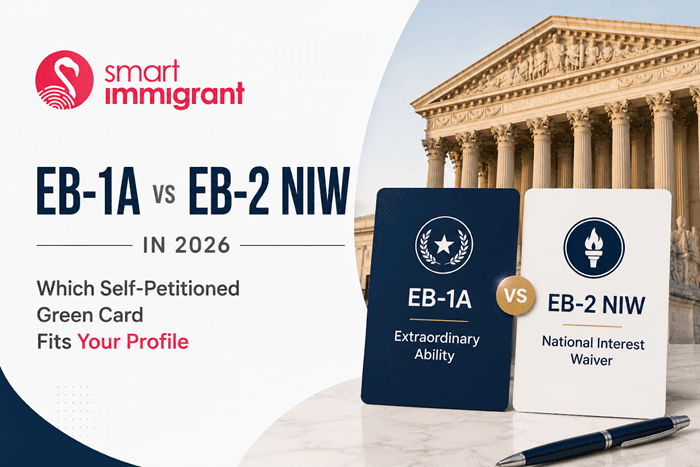
EB-1A vs EB-2 NIW in 2026: Which Self-Petitioned Green Card Fits Your Profile
EB-1A vs EB-2 NIW in 2026, backed by USCIS data: requirements, the Dhanasar test, approval rates, and which self-petitioned green card is faster for Indian applicants.
If you have already built a proven record in your field, EB-1A is usually your answer, and the data shows why it is worth the higher bar. As of December 2025, more than 351,000 India-born professionals were stuck waiting in the EB-2 green card line, against roughly 21,000 in EB-1 (USCIS). Fewer people ahead of you means a faster path to permanent residence.
So in the EB-1A vs EB-2 NIW decision, EB-1A rewards those who can show they sit among the very best in their field. EB-2 NIW is an equally strong route for a different profile: work of clear national importance that you are well positioned to advance. Here is how to choose.
What EB-1A and EB-2 NIW Have in Common
Both let you file for a green card on your own, with no employer, no job offer, and no PERM labor certification. They are the two main self petition green card USA routes for skilled professionals.
Both are filed on Form I-140, both offer optional premium processing, and both lead to permanent residence. What differs is the standard you must meet, and how quickly you get there.
EB1A Visa Requirements: What "Extraordinary Ability" Really Means
EB-1A is for extraordinary ability. You must show sustained national or international acclaim and sit among the small percentage at the very top of your field.
You meet the EB1A visa requirements through either a one-time major award (such as a Nobel Prize or Olympic medal) or at least three of ten regulatory criteria, followed by a "final merits" review of your entire record.
EB-1A has a reputation as the hardest green card to win, but the data is more encouraging than that. In the first quarter of FY2026 (October–December 2025), its approval rate among decided cases, about 47%, actually edged out EB-2 NIW's. What separates approval from denial is the strength of your evidence, which is where preparation pays off.
EB-2 NIW Visa Requirements: The Dhanasar Test Explained
The EB-2 NIW route begins with the EB-2 base. The core eb 2 visa requirements are an advanced degree (or a bachelor's plus five years of progressive experience) or exceptional ability.
On top of that, the eb-2 national interest waiver asks you to satisfy three prongs from Matter of Dhanasar:
- Your proposed endeavor has substantial merit and national importance.
- You are well positioned to advance it.
- On balance, it benefits the U.S. to waive the job offer and labor certification.
You do not need to be "the best." Still, the bar is real: USCIS approved roughly 43% of decided NIW petitions that quarter, a notch below EB-1A.
EB-1A vs EB-2 NIW: A Data-Backed Comparison
Factor | EB-1A | EB-2 NIW |
Category | First preference (EB-1) | Second preference (EB-2) |
Core standard | Extraordinary ability, top of field | Advanced degree or exceptional ability, plus national importance |
Self-petition | Yes | Yes |
Job offer / labor certification | Not required | Waived in the national interest |
The test | 3 of 10 criteria + final merits | Dhanasar three prongs |
Approval rate (FY2026 Q1, decided cases) | About 47% | About 43% |
Premium processing | About 15 business days | About 45 business days |
India green-card wait | Shorter (about 21K in line) | Far longer (about 351K in line) |
Figures from USCIS FY2026 Q1 data (as of December 2025). Quarterly rates fluctuate.
Which Is Faster for Indian Applicants? The Backlog Numbers
Adjudication speed is broadly similar. The queue is not.
As of December 2025, USCIS counted 351,177 India-born beneficiaries with approved EB-2 petitions waiting for a visa, versus 21,399 in EB-1, more than sixteen times as many people stuck in the EB-2 India line.
So when a profile can genuinely support EB-1A, it is usually the faster route to a green card for Indian applicants. The "easier" category is not the faster one.
Which Green Card Fits Your Profile?
- Researchers and scientists: EB-1A fits when your recognition extends beyond your own papers: influential citations, peer-review invitations, and impact others build on. If that acclaim is still forming, NIW bridges the gap.
- Founders and entrepreneurs: EB-1A rewards press, awards, and recognized leadership, not just a working product. Where that visibility is still growing, NIW carries a nationally important venture.
- Engineers and product leaders: EB-1A is the target when your record shows field-wide recognition or patents in real use. NIW is the practical alternative in the meantime.
- Doctors: EB-1A suits those with major recognition and leadership; NIW remains a solid route for physicians advancing national health work.
Given the India backlog, aim for EB-1A first: it is faster, fully independent, and no harder to win. NIW is the pragmatic fallback when the extraordinary ability bar is close but not yet met.
Can You File Both EB-1A and EB-2 NIW?
You cannot convert one petition into the other, but you can file a separate I-140 in the other category, or file both at once. If an earlier petition was approved, you can usually keep (port) its priority date. With NIW filed nearly twice as often (13,829 against 7,756 in a single quarter), many strong applicants file both to hedge timing and risk.
Conclusion
The EB-1A vs EB-2 NIW choice comes down to two questions: how strong is your record, and how quickly do you need a green card. EB-1A demands top-of-field acclaim but usually reaches permanent residence faster, especially for Indian applicants. EB-2 NIW rewards important, well-positioned work with a more accessible standard. And on the latest USCIS numbers, EB-1A is no harder to win than NIW while getting you there sooner.
Still not sure whether EB-1A, EB-2 NIW, or both is right for you?
Book a free consultation with Smart Immigrant for an honest, evidence-based read on your best route to a U.S. green card.
Frequently Asked Questions
Which US green card category is faster for Indian applicants?
For most applicants, the EB-1A green card is faster than EB-2 because it has a much shorter visa backlog for India, even though USCIS processing times are similar.
Can I switch from EB-2 NIW to EB-1A during the application process?
You cannot convert an existing petition, but you can file a new EB-1A petition while your EB-2 NIW case is pending and may retain your original priority date if eligible.
What are the requirements for an EB-1A green card from India?
The EB1A visa requirements are the same for all nationalities: demonstrate sustained national or international acclaim through a major award or by meeting at least three of the ten USCIS criteria.
Who are the top-rated immigration consultants in India for EB-1A and EB-2 NIW petitions?
Trusted by hundreds of professionals, Smart Immigrant combines strategic profile building, a 90%+ EB-1A approval rate, and licensed U.S. immigration attorneys to support EB-1A and EB-2 NIW petitions.
What are the criteria for a national interest waiver application for researchers?
A National Interest Waiver (EB-2 NIW) application requires meeting the EB-2 eligibility criteria and the three Dhanasar prongs, supported by strong evidence such as citations, research impact, funding, and expert recommendation letters.
Read More - EB1A Visa Guide: EB1A Visa Requirements, Eligibility Criteria & Application Process