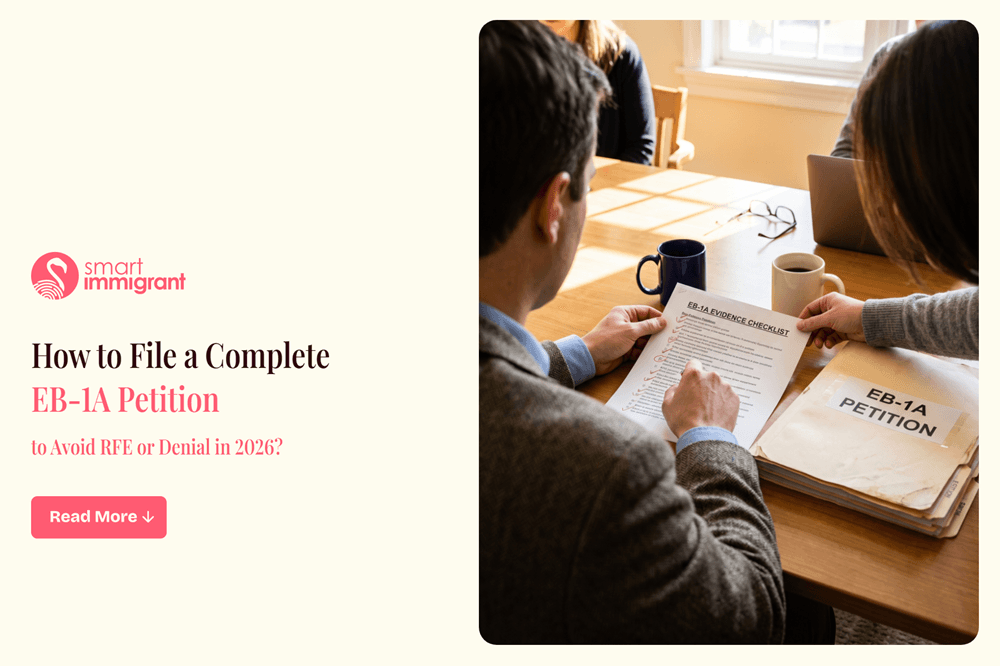
How to File a Complete EB-1A Petition to Avoid RFE or Denial in 2026
Build an EB-1A Petition that survives the final merits review: the documents checklist, the 3-of-10 evidence standard, common denial triggers, and what to do after a denial.
Most EB-1A cases are not lost at the interview. They are lost the day they are filed, when a thin or disorganized EB-1A Petition invites a Request for Evidence, or worse, a straight denial. In 2026, USCIS can and does deny extraordinary-ability cases outright, without asking for more.
The good news is that this is largely in your control. A complete, well-argued petition front-loads the evidence and the legal argument so USCIS has no reason to doubt you. This guide shows how to build one that holds up: documents, the evidence standard, the mistakes that trigger denials, and what to do if a denial comes anyway.
Can USCIS Deny an EB-1A Without an RFE?
Yes. USCIS can deny an EB-1A outright, with no RFE, if the initial petition does not establish eligibility.
This is the most misunderstood fact about the category. Many applicants treat filing as a first draft, assuming an RFE will give them a second chance to fix gaps. That assumption is how strong profiles get denied, so your petition must be complete and persuasive on day one (USCIS).
Smart Immigrant Insight: Treat every EB-1A application as if there will be no RFE. If the case only works after a second round of evidence, it is not ready to file. |
How Does the EB-1A Standard Actually Work?
You must meet three of ten criteria (or a major award), then pass a separate final merits review, where most denials actually happen.
The EB1A eligibility criteria are only step one. USCIS applies a two-step review: it counts whether you meet three criteria, then makes a final merits determination, weighing all your evidence to decide if you are truly among the small percentage at the top of your field (USCIS Policy Manual). Applicants often clear three boxes on paper but fail to prove sustained acclaim overall, so a strong petition argues both steps.
What Documents Are Needed for an EB-1A Petition?
Form I-140, a detailed petition letter, independent expert letters, and primary proof for every criterion you claim.
A strong EB1A documents checklist maps every claim to proof:
- Form I-140 and filing fee.
- A detailed petition letter tying your evidence to each criterion and to the final merits argument.
- Six to eight recommendation letters, ideally from independent experts, not just close colleagues.
- Primary evidence for each claimed criterion: awards, media about you, citation and download records, patents, salary data, membership proof.
- Your CV, degrees, and credentials.
The theme is independent, verifiable proof: self-described importance without third-party backing is the weakest evidence, and the easiest to deny.
How Do I File a Complete EB-1A Petition?
Gather independent evidence first, pick your three strongest criteria, then argue both the criteria and the final merits in one complete filing.
Here is how do I file a complete EB-1A petition in practice:
- Assess honestly against the ten uscis eb1a criteria, and pick the three to five you can prove strongly.
- Gather independent evidence first, so the argument follows the proof.
- Write the petition letter to argue both the criteria and the final merits, not just list exhibits.
- Secure expert letters that explain why your work matters, backed by specifics.
- Index everything and file Form I-140, so an officer finds each proof in seconds; add premium processing if speed matters.
Common Mistake: Filing five weak criteria instead of three strong ones. USCIS weighs quality, not quantity: one patent in commercial use beats three thin certificates. |
What Evidence Does USCIS Consider Strong?
Specific, independent, measurable proof, like citation counts, patents in use, and major-media features, beats anything self-reported.
Strong evidence is specific, independent, and measurable; weak evidence is vague or self-serving.
- Strong: A widely cited paper with citation counts, a patent in real-world use, major-outlet media, a documented top-percentile salary, or a critical role at a renowned organization.
- Weak: Manager-only letters, company-internal awards, easy-to-join memberships, and unverified claims of impact.
Expert Tip: Quantify everything. "Highly cited" is an opinion; "412 citations across 30 countries" is evidence. Numbers and independent sources move a final merits determination. |
Conclusion
A successful EB-1A Petition is won before it is filed. Assume there will be no RFE, meet the EB1A visa requirements through three strong criteria, argue the final merits directly, and back every claim with independent, quantified proof. If a denial comes, diagnose why before refiling: a strong record poorly presented can be rebuilt, but more of a thin one cannot.
If you are still asking "am I eligible for an EB1A green card," or want a second set of eyes before filing, a professional profile evaluation can help identify the strongest immigration pathway for your goals.
Frequently Asked Questions
Can USCIS deny an EB-1A petition without issuing an RFE in 2026?
Yes. USCIS is not required to issue an RFE and can deny outright if the filing does not establish eligibility. That is why the answer to "Can USCIS deny an EB-1A without an RFE?" is a clear yes, and why every petition must be complete on filing.
What are the most common reasons USCIS denies an EB-1A petition without an RFE?
The usual reasons: failing the final merits determination despite meeting three criteria, weak or self-serving evidence, and a disorganized record. Denials often trace back to proving activity rather than top-of-field acclaim.
How do I prepare a complete EB-1A petition to avoid an RFE or denial?
Gather independent, verifiable evidence first, then write a petition letter arguing both the criteria and the final merits. Meeting three of ten strongly, with quantified proof and independent expert letters, is what makes an eb1a application hard to deny.
What documents are required for an EB-1A petition in 2026?
The core answer to "What documents are needed for an EB-1A petition?" is Form I-140, a detailed petition letter, independent recommendation letters, and primary proof for each criterion (awards, citations, patents, media, salary), plus your CV and credentials.
How can I prove I meet at least 3 of the 10 EB-1A criteria?
Document each criterion with independent, third-party evidence, not assertions: prove original contributions with citations or adoption metrics, and a critical role with letters and organizational evidence from a distinguished employer.
What evidence does USCIS consider strong for an EB-1A petition?
USCIS values specific, independent, measurable proof: highly cited work, patents in use, major media features, a documented high salary, and independent expert letters. Vague claims and internal-only awards are treated as weak.
What should I do if my EB-1A petition is denied without an RFE?
Diagnose why first: if the record was strong but poorly presented, a rebuilt petition can succeed; if it was genuinely thin, more of the same will not. Review the denial notice with a licensed attorney before deciding.
Can I refile an EB-1A petition after a denial without an RFE?
Generally yes, you can file a new I-140, and you may also consider a motion to reopen or reconsider, or an appeal, depending on the facts. The right choice depends on why the case was denied, so get professional review before refiling.