OPT to Green Card Explained: What Are Your Options After F-1 OPT in 2027?
OPT gives international students an opportunity to gain practical work experience in the United States, but it does not provide a permanent immigration pathway. This guide explores how to transition from OPT to Green Card status through EB-1A, EB-2 NIW, employer-sponsored categories, and EB-5, covering eligibility, costs, timelines, and planning strategies.
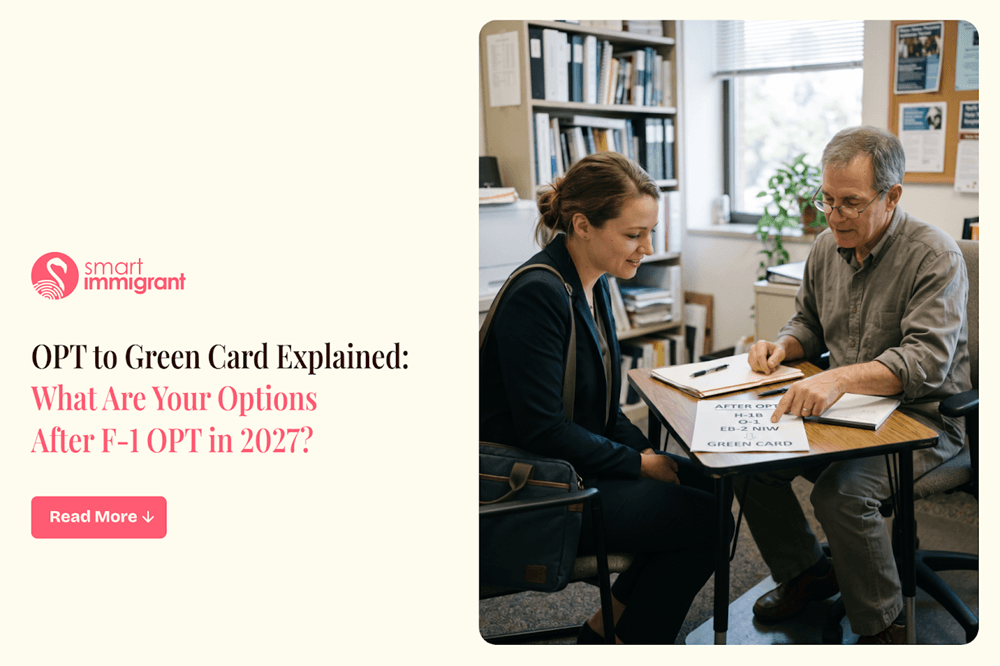
In 2024, more than 340,000 international students held post-completion OPT authorization, with another 165,000 on the STEM OPT extension. For each of them, OPT is a milestone: the move from the classroom to a first real job in the US. But OPT is a temporary stepping stone, not the safe shore you are trying to reach.
Your OPT clock is ticking, the H-1B lottery remains uncertain, and a bigger question sits behind that first job: how do you turn a temporary work permit into a United States green card and a permanent future here? That is what the OPT to Green Card path is really about.
If you are on OPT or preparing to transition from F-1, this guide breaks down your realistic options, including eligibility, costs, processing timelines, and when to start preparing.
Can OPT Students Apply for Green Cards?
The first and foremost evergreen doubt among the fresh OPT students is “Can OPT Students Apply for Green Cards?”
Yes, absolutely.
OPT is temporary work authorization tied to your F-1 status, while a green card is permanent residence. You can pursue EB-1A, EB-2 NIW, EB-2, EB-3, and EB-5 while on OPT if you meet the requirements. But an approved Form I-140 grants no status or work authorization, a pending petition does not extend OPT, and the 60-day grace period after OPT is not work authorization either.
What Are Your Green Card Options After OPT?
If you are researching how to get a green card in the USA as a graduate, the F1 student visa to green card routes fall into four buckets.
Route | Employer needed? | H-1B lottery? |
EB-2 / EB-3 (employer-sponsored) | Yes | Usually |
EB-1A (self-petition) | No | No |
EB-2 NIW (self-petition) | No | No |
EB-5 (investment) | No | No |
Employer-sponsored EB-2 and EB-3 run through PERM, then I-140, then I-485 when a visa number is available. The self-petition and EB-5 routes skip the employer. Notably, the three EB-5 set-aside categories ($800,000 minimum in a targeted-employment-area project) are current for India in the November 2026 Visa Bulletin, a fast lane most guides miss.
How to Get a Green Card After OPT Without the H-1B Lottery
The case for skipping the lottery grew stronger in 2026. A DHS final rule effective February 27, 2026 weighs H-1B selection by salary: a Level IV wage earns four entries, down to one at Level I (DHS). Fresh graduates usually sit at the lower levels, so the odds move against them.
That is why two self-petition categories matter. How to get a green card after OPT, without the lottery, comes down to these.
- EB-1A (Extraordinary Ability): self-petition on a record of major achievements, with no employer or job offer.
- EB-2 NIW (National Interest Waiver): self-petition for work of national importance, waiving the employer and labor certification.
For a strong profile, these are often the cleanest route to US permanent residency, because eligibility rests on you. Both allow premium processing on the I-140 (15 business days for EB-1A, 45 for NIW), which speeds the petition decision, not the visa.
Smart Strategy: OPT is the ideal window to build the evidence, publications, patents, press, talks, and expert letters, while you work in your field.
How Long From OPT to Green Card?
There is no single green card processing time; your priority date dominates, set by category and country of birth. For India, category choice is a timeline choice. According to the November 2026 Visa Bulletin Final Action Dates:
Category | India Final Action Date |
EB-1 | February 1, 2023 |
EB-2 | November 1, 2013 |
EB-3 | January 22, 2014 |
For an Indian graduate, EB-1 is roughly a decade ahead of EB-2 and EB-3, so EB-1A can be far faster. Most of the world is currently in EB-1 and can finish in about a year.
The bulletin has two charts. Dates for Filing often lets you file I-485 earlier than Final Action Dates: India's EB-1 Dates for Filing reached July 1, 2024, so you may file, and unlock a work permit, before the green card is available. Always check which chart USCIS honors that month.
Smart Strategy: If you are married, cross-chargeability may let you use a spouse's country of birth for the priority date (INA 202(b)), which can erase years of backlog.
What Does the Green Card Cost?
Most guides give no numbers. For a self-petition (EB-1A or EB-2 NIW), here is a 2026 reference estimate; confirm each amount on the USCIS fee schedule before filing.
Item | Approximate cost |
Form I-140 | $715 |
Asylum Program Fee (individual self-petitioner) | $300 |
Premium processing (optional) | $2,965 |
Form I-485 | $1,440 |
Form I-765 EAD and Form I-131 advance parole | See USCIS schedule |
Remember that an I-140 approval is not a green card approval.
Important Update: Is F-1 Duration of Status Changing?
In July 2026, DHS published a rule replacing F-1 "duration of status" with a fixed four-year admission period. A federal court blocked it nationwide on September 14, 2026, before it took effect, and litigation continues. So as of November 2026 the rule is not in force, and F-1 students are still admitted for duration of status.
When Should You Start Planning?
Earlier than most students do. At the start of OPT, pick your category and the evidence you need. During STEM OPT, build achievements and discuss employer options. In the 12 to 18 months before OPT ends, prepare your self-petition or start PERM, and plan status separately from the immigrant petition.
Common Mistake: waiting for the H-1B result before planning your green card. That burns a year of OPT you could spend building an employer-independent case.
Final Thoughts
The OPT to Green Card journey is wider than the lottery-or-bust story, and with the lottery now tilted toward higher salaries, employer-independent routes matter more than ever. Start early, pick the right category for your country of birth, and build around your qualifications rather than the H-1B draw.
If you are unsure whether EB-1A, EB-2 NIW, or an employer-sponsored pathway fits, a structured profile assessment can help identify your strongest options and next steps.
Frequently Asked Questions
Can international students apply for a green card while on OPT in the USA?
Yes. OPT is temporary work authorization, while the green card is a permanent residency option. So you can start the green card process while on OPT or STEM OPT.
What are the different ways to get a green card after F-1 OPT?
The main routes are employer-sponsored (EB-2 or EB-3 through PERM), self-petition (EB-1A or EB-2 NIW with no employer), and investment (EB-5). Each ends with Form I-485 once a visa number is available.
Can I apply for an EB-1A green card while working on STEM OPT?
Yes. EB-1A is a self-petition, so you can file Form I-140 yourself while on STEM OPT, with no employer or job offer. STEM OPT is a strong window to build the achievements EB-1A requires.
Can I transition from OPT to EB-2 NIW without employer sponsorship?
Yes. The EB-2 National Interest Waiver waives the job offer and the labor certification, so you can self-petition directly from OPT. You still need an advanced degree or exceptional ability and work that serves the US national interest.
What happens if my OPT or STEM OPT expires while my green card petition is pending?
A pending I-140 or I-485 does not by itself extend your OPT work authorization. You generally need another status, such as H-1B, or a pending I-485 with its own work permit, so plan the overlap to avoid falling out of status.
Can I apply for a green card without going through the H-1B lottery?
Yes. EB-1A, EB-2 NIW, and EB-5 all lead to a green card without the H-1B lottery, since none require H-1B status or employer sponsorship. A self-petition is often the most reliable way to skip the lottery entirely.
How can international students build an EB-1A profile during OPT?
Use your OPT period to publish, present, contribute original work, earn recognition, and gather strong letters from independent experts. Documenting real impact while working in your field is what turns a resume into an EB-1A case.
When should F-1 students start planning their green card application before OPT expires?
Ideally from the start of OPT, and no later than 12 to 18 months before it ends. Self-petition cases take time to build and employer cases involve PERM, so early planning keeps you from running out of work authorization first.