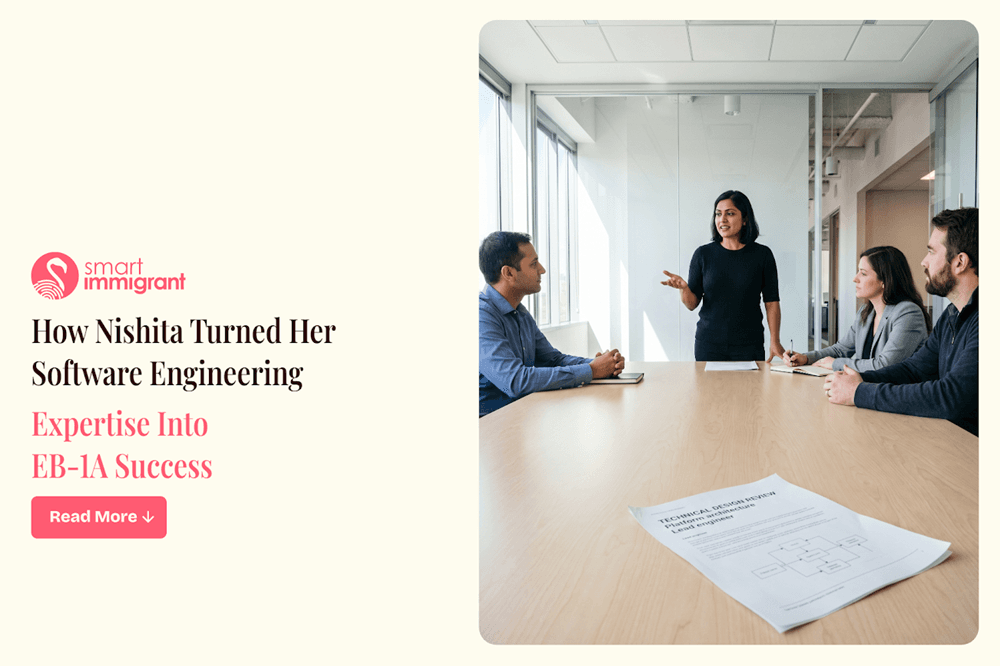
How Nishita Turned Her Software Engineering Expertise Into EB-1A Success
This case study outlines how Nishita, a full-stack software engineer specializing in healthcare insurance technology, secured EB-1A approval. Her experience included developing Medicare portals for government and private entities and contributing to broader healthcare technology initiatives, while her employer-sponsored EB-2 path left her facing prolonged immigration uncertainty. The challenge was not a lack of professional achievements, but understanding how her existing expertise and contributions aligned with the EB-1A criteria. Her profile revealed strengths across eight criteria, including authorship, judging, awards, media, original contributions, and critical role. These achievements were strategically developed, documented, and connected to present a cohesive story of expertise, recognition, and impact, resulting in an EB-1A petition approval without an RFE.
- NationalityIndian
- Previous Immigration StatusEmployer-sponsored EB-2
How Nishita’s Healthcare Technology Career Shaped Her EB-1A Profile
Nishita built her career at the intersection of software engineering and healthcare insurance, developing technology that supported Medicare-related processes for government and private entities.
Her work began with full-stack development of Medicare portals, where she helped build and improve technology used in a complex healthcare environment. This experience gave her more than technical expertise, it gave her a deep understanding of how software can support critical healthcare and insurance processes.
As her career progressed, Nishita became more deeply involved in the broader aspects of healthcare insurance. Her experience expanded beyond software development into work that contributed to larger systems, processes, and initiatives within the field.
For years, these accomplishments were simply part of Nishita’s professional journey. She had built expertise, contributed to meaningful projects, published research, and developed recognition in her field. But she had not previously looked at these achievements through the lens of an EB-1A petition.
That changed when she began exploring whether her professional experience could form the foundation of an EB-1A case.
Why Did Nishita Look Beyond Her EB-2 Green Card Path?
Nishita had already started pursuing an EB-2 green card through her employer more than a year earlier.
But while continuing her career in the U.S., she remained caught in the lengthy PERM and I-140 processes, with her EB-2 petition still awaiting approval. The significant backlog associated with the EB-2 category added further uncertainty to her long-term immigration plans.
For Nishita, the situation was about more than waiting for a petition to move forward. The uncertainty also meant reduced flexibility in her professional future in the U.S.
Rather than continuing to rely on a single pathway, she began looking into other employment-based green card options.
During that search, Nishita came across Smart Green Card’s YouTube videos and learned about the EB-1A pathway and its requirements. As she explored the category, she began to recognize that her own career and achievements could potentially align with the requirements.
That realization gave her a new direction.
She decided to pursue EB-1A and joined the Smart Green Card VIP plan to support her through the process of understanding, developing, and documenting her case.
What Strengths in Nishita’s Profile Aligned With EB-1A?
Nishita initially approached EB-1A with some misconceptions. She believed that she needed a PhD to pursue the pathway and wasn't sure how her existing software engineering experience could translate into the requirements.
As she began examining her profile more closely, Nishita discovered that her career contained several areas that could potentially support an EB-1A case.
Her experience in healthcare technology, research, professional recognition, judging, and industry contributions provided a foundation. The next step was understanding how those achievements could be documented and positioned effectively.
Through detailed profile discussions and deep dives into her professional background, Nishita developed a clearer understanding of where her strengths aligned with the EB-1A criteria.
She ultimately focused on eight EB-1A criteria:
- Original Contribution
- Critical Role
- High Salary
- Awards
- Authorship
- Media
- Judging
- Membership
This gave Nishita a structured direction for building her case while allowing her to continue developing evidence around the expertise she had already established.
Which EB-1A Evidence Helped Nishita Stand Out?
Nishita's case brought together achievements from different stages of her career, along with evidence she developed throughout her EB-1A journey.
EB-1A Evidence Area | Nishita’s Achievement | Evidence & Impact Demonstrated |
Authorship | 18 impactful research papers | Nishita rebuilt her publication profile around topics aligned with her expertise. Many of her papers received organic citations because of their relevance to further industry research. |
Awards | 5 professional awards | She pursued multiple peer-nominated opportunities and secured five awards recognizing her professional contributions. |
Judging | 14 judging activities | Her judging experience included peer reviews, Globee Awards, and book chapter reviews, demonstrating her expertise and ability to evaluate the work of others. |
Media | 12 media coverages | She expanded beyond initial local coverage and secured broader media recognition of her professional achievements. |
Original Contribution | Work used by several hospitals | Her citations were examined beyond the numbers to understand their significance. Evidence from hospitals that used her work to upgrade their processes helped demonstrate its practical impact. |
Critical Role | Significant project within her organization and field | Evidence documented the project's importance and Nishita's specific contribution, demonstrating the significance of her role beyond routine job responsibilities. |
High Salary | Compensation reflecting her professional standing | Compensation evidence supported her standing within her field. |
Membership | Relevant professional memberships | Supporting documentation demonstrated her participation in relevant professional organizations and strengthened her broader professional profile. |
Building Toward Final Merits Determination
Nishita's case became stronger as her individual achievements came together into a broader story of expertise, recognition, contribution, and impact.
Her publications, citations, hospital applications, awards, judging activities, and media coverage each contributed a different dimension to her professional profile.
Rather than waiting until the end of the process to think about Final Merits Determination, Nishita gathered evidence demonstrating the broader significance of her achievements throughout the journey. This helped ensure that valuable evidence was documented while her accomplishments and professional recognition were developing.
How Did Nishita Turn Her Achievements Into an EB-1A Case?
Nishita's strategy was built around her actual professional experience in software engineering and healthcare technology.
The goal was not to add unrelated accomplishments simply to satisfy a checklist. Instead, her existing strengths were examined, gaps were identified, and evidence was developed around areas that genuinely connected to her expertise.
Her journey involved several interconnected steps:
- Understanding her profile: Nishita examined her professional experience through the lens of EB-1A rather than simply viewing it as a collection of job responsibilities.
- Rebuilding authorship: She developed research around areas connected to her expertise and ultimately published 18 impactful papers.
- Expanding recognition: She pursued peer-nominated awards and secured five awards recognizing her contributions.
- Developing judging experience: She participated in 14 judging activities across peer reviews, Globee Awards, and book chapter reviews.
- Strengthening media recognition: She expanded her media presence to 12 coverages.
- Documenting real-world impact: Her work's use by several hospitals provided evidence of practical application.
- Establishing critical role: She documented her contribution to a significant project within her organization and field.
- Preparing for final merits: Evidence demonstrating the broader significance of her achievements was developed alongside the individual criteria.
- Refining the petition: An attorney partner within the Smart Green Card program supported the refinement and finalization of the petition package.
The strategy gave Nishita a way to bring together different parts of her career into a focused EB-1A narrative built around expertise, contribution, recognition, and impact.
The Challenges Along the Way
Nishita's EB-1A journey required her to overcome several challenges along the way:
- She initially believed a PhD was necessary to pursue EB-1A.
- Her earlier publications were not closely connected to her current area of expertise.
- She had a significant gap in her publishing history.
- She needed to demonstrate the significance of her work beyond her formal job responsibilities.
- Her initial media recognition was largely local and limited in prominence.
- She had to actively pursue awards and judging opportunities.
- Developing strong evidence required sustained effort alongside her existing career.
- She needed to identify and preserve evidence demonstrating the impact of her work.
Throughout the journey, Nishita remained actively involved in developing her profile and pursuing the opportunities that could strengthen her case.
As she reflected on the experience:
“Smart Green Card has a truly great team that pinpointed tailored strategies to my profile. They supported me in overcoming challenges in the EB1A path.” |
The Outcome: Turning Strategy Into Success
Nishita's EB-1A petition was approved without any Requests for Evidence.
The approval came after a sustained period of professional development and evidence building. What began as uncertainty about whether her software engineering experience could support an EB-1A case evolved into a profile supported by publications, professional recognition, judging activities, media coverage, original contributions, and critical-role evidence.
The outcome represented more than meeting individual criteria. Her approval was not the result of a single achievement. It represented the cumulative value of years of specialized work and the effort she put into developing and documenting that work.
For Nishita, the journey transformed a question she once had: “Is my profile enough for EB-1A?” into a successful outcome.
What Can Nishita’s Journey Teach Other EB-1A Aspirants?
Your Existing Career May Hold More Evidence Than You Realize
Nishita did not begin her EB-1A journey with a perfect checklist of achievements. She began with a career she had already built.
Looking more closely at her software engineering and healthcare technology experience revealed opportunities that she had not initially recognized as relevant to an EB-1A case.
Gaps Do Not Always Mean the Journey Has to Stop
Nishita had published papers in the past, but they were not closely aligned with her current expertise, and she had stopped publishing.
Instead of treating that gap as a permanent weakness, she built a new authorship record around topics connected to her field. Her journey eventually resulted in 18 impactful publications.
Evidence Needs to Show More Than What You Did
A job description can explain what someone was responsible for. It doesn't necessarily explain why that work mattered.
Nishita's case became stronger as she documented the impact, application, recognition, and significance associated with her work.
Building Evidence Is an Active Process
Nishita's awards, judging activities, publications, and media recognition developed through consistent effort.
Her journey demonstrates that building an EB-1A profile can involve actively pursuing opportunities while continuing to grow professionally.
The Individual Pieces Need to Tell One Larger Story
Publications, citations, awards, judging, media coverage, original contributions, and critical roles can appear disconnected when viewed individually.
Nishita's case brought these achievements together around a central story: a software engineer with specialized expertise whose work demonstrated contribution, recognition, and impact within healthcare technology.
Could Your Expertise Be the Foundation of an EB-1A Case?
Yes. The current CTA feels a little generic and repeats the case-study summary. For Nishita, I’d make the CTA more emotionally connected to her starting point—uncertainty, an existing career, and realizing that her experience may be more valuable than she thought.
Recommended CTA
Could Your Career Hold More EB-1A Potential Than You Think?
Nishita didn't start her EB-1A journey knowing exactly how her experience would fit the criteria. She started with a strong career in software engineering and healthcare technology, and a simple question: Could her professional achievements support an EB-1A case?
The answer became clearer once her expertise, contributions, recognition, and professional impact were examined together.
Your path may look different from Nishita's. But if you've built years of specialized experience, contributed to meaningful projects, published research, earned recognition, or influenced your field, there may be more to your profile than you realize.
Don't guess whether your profile is strong enough for EB-1A. Understand where you stand.
Book a free profile review with our immigration experts and explore whether your professional achievements could support your EB-1A journey.
FAQs
Does EB-1A require a PhD?
Nishita initially believed that a PhD was necessary. Her journey focused instead on evaluating her professional achievements, expertise, recognition, and supporting evidence.
How many EB-1A criteria did Nishita pursue?
Nishita focused on eight criteria: original contribution, critical role, high salary, awards, authorship, media, judging, and membership.
How did Nishita strengthen her EB-1A evidence?
She developed evidence across multiple areas, ultimately publishing 18 impactful papers, securing 5 awards, completing 14 judging activities, and obtaining 12 media coverages, alongside evidence of original contribution and critical role.
Was Nishita’s EB-1A petition approved without an RFE?
Yes. Nishita's EB-1A petition was approved without any Requests for Evidence, following the development and strategic presentation of her professional achievements and supporting evidence.