US Court Hears Challenge to Trump’s D/S Student Visa Rule
The D/S Student Visa Rule is facing a federal court challenge that could change how international students maintain their status in the US. Learn how the proposed fixed admission periods may affect F-1 students, OPT, and long-term immigration plans.
D/S Student Visa Rule: What Students Need to Know
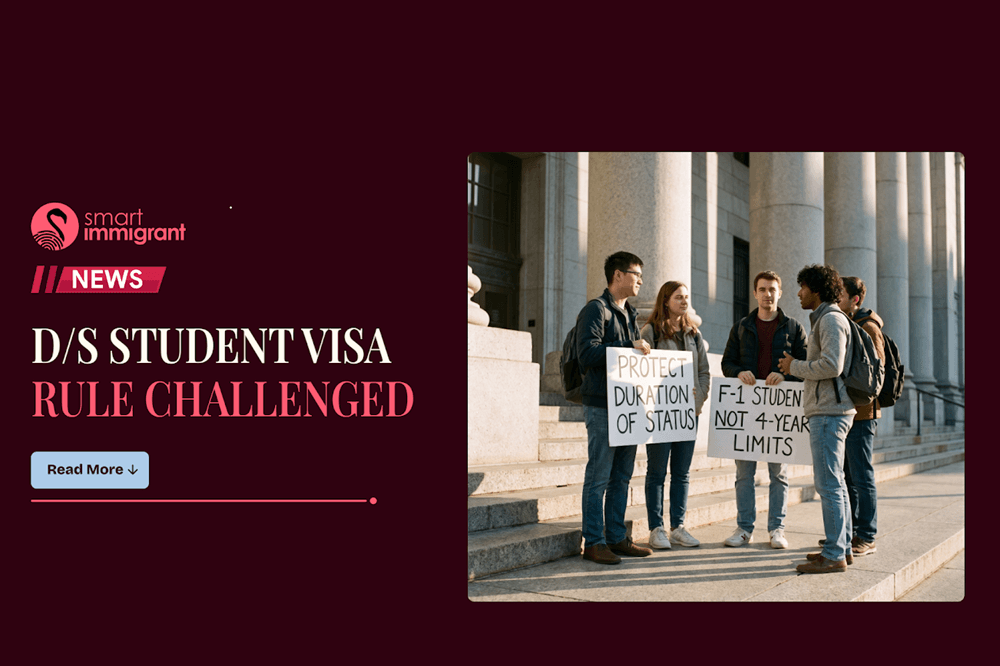
A US federal court has heard arguments against the Trump administration’s plan to end the longstanding “Duration of Status” (D/S) system for international students and exchange visitors. The proposed change would replace D/S with fixed admission periods of up to four years, potentially affecting students whose academic programmes, training or Optional Practical Training extend beyond that period.
Why Is the D/S Student Visa Rule Facing a Court Challenge?
The US District Court for the District of Massachusetts heard oral arguments on September 3 in a lawsuit filed by higher-education associations and unions. The coalition is seeking to block the Department of Homeland Security (DHS) rule before its scheduled September 15, 2026 implementation date.
The plaintiffs argue that DHS:
- Failed to adequately assess the rule’s costs and benefits
- Did not sufficiently address public comments
- Did not consider less burdensome alternatives
- Exceeded its statutory authority
The court has not yet issued a ruling. Until September 15, the existing D/S framework remains in effect.
How Could the New Rule Affect F-1 Students?
The biggest change for F-1 students is the shift from flexible D/S status to a fixed admission period. Under the current system, students who maintain their status can generally remain in the US for the duration of their academic programme. Under the proposed framework:
- Students in programmes lasting more than four years may need to apply for an extension of stay.
- PhD and research students who need additional time to complete their programmes could face additional immigration filings.
- Students whose OPT or STEM OPT plans require additional time could also face new extension requirements.
- Students changing their educational objective, transferring schools or pursuing additional programmes may face additional procedures.
- Students would have greater responsibility for securing additional authorization if their fixed admission period is not enough.
Importantly, the rule does not mean students cannot complete programmes lasting longer than four years. Eligible students could still request additional time; the key change is that they would need to formally seek an extension instead of continuing under D/S.
Why Are Indian Students Watching the Case?
The change could be particularly significant for Indian students enrolled in doctoral, research or other programmes that take longer than four years. Students planning pathways such as F1 to H1B visa status or eventually an F1 student visa to Green Card pathway could also face additional immigration planning requirements if they need to extend their stay.
Higher-education groups have warned that increased paperwork and uncertainty could make it harder for US universities to attract and retain international talent.
With the September 15 deadline approaching, the court’s decision could determine whether the new D/S framework takes effect as scheduled or faces a legal roadblock. For Indian students planning to study, work or build a long-term immigration pathway in the US, the outcome could have significant implications for future visa planning.
For more information on the new D/S student visa rule and the latest updates, visit the USCIS official website.
Stay connected with Smart Immigrant for more updates on US immigration and policy changes.
Read Full News Here: