EB-2 NIW Requirements 2026: USCIS Eligibility Criteria Explained
A clear 2026 guide to EB2 NIW Visa Requirements: the EB-2 base, the three-prong Dhanasar test, how to self-petition, evidence, and common denial reasons.
Having someone else determine your future is rarely ideal, yet that is often the case with traditional employment-based green cards. You join a company, they file the petition on your behalf, and if you lose that job, your future is at risk. For many skilled professionals, this dependence is what keeps them stuck.
But what if there is another way? The EB-2 NIW allows you to petition for yourself, bypassing the need for an employer, a job offer, or a labor certification.
The EB2 NIW Visa Requirements make this National Interest Waiver, or NIW, one of the more realistic routes to US permanent residency, built for people whose work genuinely matters to the country, from researchers and founders to engineers and doctors.
This guide explains the EB-2 NIW requirements for 2026, including eligibility, evidence, filing steps, and common mistakes.
What Is the EB-2 NIW?
The EB-2 is a second-preference, employment-based green card. Usually it comes with strings: a US employer, a job offer, and a labor certification showing no qualified American could take the role.
The National Interest Waiver cuts the last two loose. If your work serves the national interest, USCIS lets the job offer and labor certification go, and you self-petition by filing Form I-140 yourself. For most people, that is the whole reason to choose it.
What Are The Two Layer EB2 NIW Visa Requirements?
Meeting the EB2 NIW Visa Requirements really happens in two steps, and the people who get denied usually only understand one of them. Step one is qualifying for EB-2. Step two is earning the waiver, which USCIS decides using the three-prong Dhanasar test.
Layer 1: Qualify for EB-2
You clear the base EB 2 visa requirements in one of two ways (USCIS):
- Advanced degree: a US master's or higher, or a bachelor's plus five years of progressive experience in your field. These EB-2 NIW advanced degree requirements are what most applicants lean on.
- Exceptional ability: meeting at least three of six USCIS criteria showing your expertise sits well above the norm in the sciences, arts, or business.
Layer 2: Pass the Dhanasar Test
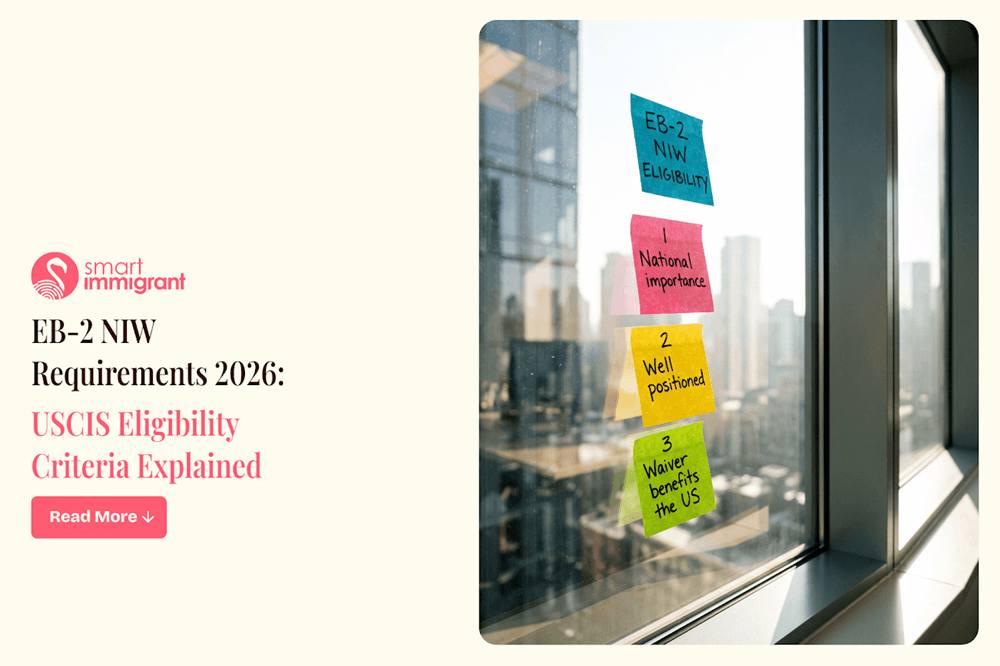
The waiver comes down to three questions from Matter of Dhanasar (USCIS Policy Manual):
- Your proposed endeavor has substantial merit and national importance.
- You are well positioned to advance that endeavor.
- On balance, it would benefit the US to waive the job offer and labor certification.
Common Mistake: spending the whole petition proving you are talented, and forgetting to prove your work matters to the country. That first prong is about the work, not your resume. The petitions that win say plainly what the endeavor is, then show how far it reaches. |
Am I Eligible for EB2 NIW?
Two questions get you most of the way there.
- Do you have an advanced degree or exceptional ability?
- does your work matter beyond whoever happens to employ you?
So, am I eligible for EB2 NIW as a founder or an independent researcher? Usually, yes. Those are exactly the people it was made for, where the impact is real but no single company owns it. A founder tackling a national problem, or a researcher whose work gets cited everywhere, tends to fit.
Smart Immigrant Insight: The NIW rewards focus. The applicants who do best pick one clear endeavor, say, healthcare AI for rural clinics, and tie everything back to it. A scattered list of accomplishments, however impressive, rarely lands as well. |
How to File an EB-2 NIW Petition?
In practice, how to file an EB-2 NIW petition looks like this:
- Confirm you meet EB-2 through an advanced degree or exceptional ability.
- Define your endeavor and gather evidence for all three Dhanasar prongs.
- Draft a detailed petition letter and secure independent recommendation letters.
- File Form I-140 yourself, with supporting evidence.
- Once your priority date is current, file for the green card through adjustment of status or consular processing.
Because this is a Self Petition Green Card USA route, the timeline and the filing are yours. Nobody has to sponsor you, and no employer has to stick around for it.
Evidence That Wins an NIW
The NIW petitions that get approved tend to share one thing: independent, checkable proof, all pointing at one clearly defined endeavor.
- A personal statement defining the endeavor and its national importance.
- Independent expert letters explaining why your work matters.
- Evidence of impact: citations, adoption, patents, funding, media, or commercial use.
- Proof of your EB-2 qualification: degrees, transcripts, or exceptional-ability evidence.
It all comes back to outside validation. Telling USCIS your work matters, with nobody else backing that up, is the weakness officers flag most.
EB-2 NIW vs Other Options
If you are weighing your employment-based immigration options, the NIW is not the only self-petition door. EB-1A is the other one, and picking between them matters.
Factor | EB-2 NIW | EB-1A |
Standard | Advanced degree or exceptional ability, plus Dhanasar | Extraordinary ability, top of field |
Self-petition | Yes | Yes |
Job offer | Waived | Not required |
Best for | National-importance work | Proven, top-tier acclaim |
For Indian applicants especially, EB-1 usually has a shorter backlog than EB-2, so people who qualify for both often file EB-1A first for speed and keep NIW in their back pocket.
Conclusion
The EB2 NIW Visa Requirements reward people whose work serves the national interest, and the payoff is real: a green card you can chase without an employer holding the reins. Qualify for EB-2, prove your endeavor matters under the Dhanasar test, and back every claim with proof someone else can verify.
That is really what separates a strong profile from an approval, knowing How to get Green Card in US by self-petition, and documenting it properly. If you are not sure how any of this fits your situation, a professional profile evaluation can help point you toward the strongest pathway for your goals.
Frequently Asked Questions
What documents are essential for an EB 2 visa application?
You need Form I-140, proof you qualify for EB-2 (degrees and transcripts, or exceptional-ability evidence), a detailed petition letter, and independent recommendation letters. For the NIW itself, add proof tying your endeavor to national importance: citations, adoption, patents, or funding.
Can I use premium processing services for EB 2 visa petitions?
Yes. Premium processing is available on Form I-140 and commits USCIS to act within a set number of business days, which is why many self-petitioners use it. Just remember it speeds up the decision on your petition, not the green card itself, which still waits on your priority date.
How does a master's degree or higher qualify for an EB 2 visa?
A US master's or higher, or a bachelor's plus five years of progressive experience, meets the EB-2 NIW advanced degree requirements. That is the base most NIW applicants start from before they ever get to the waiver itself.
What are the common reasons for EB 2 visa application denials?
Most denials trace back to the same few things: not showing national importance under Dhanasar, leaning on your own say-so without outside proof, or describing a vague, shifting endeavor. Put simply, proving you are talented but never proving why the work matters.
What constitutes "exceptional ability" for an EB 2 petition?
Exceptional ability means expertise well above what you would ordinarily see, proven by meeting at least three of six USCIS criteria: an advanced degree, ten years of experience, licensure, a high salary, professional memberships, or recognition. It is the other way to meet the EB-2 base, alongside the advanced-degree route.
Read More: EB-1A vs EB-2 NIW in 2026: Which Self-Petitioned Green Card Fits Your Profile