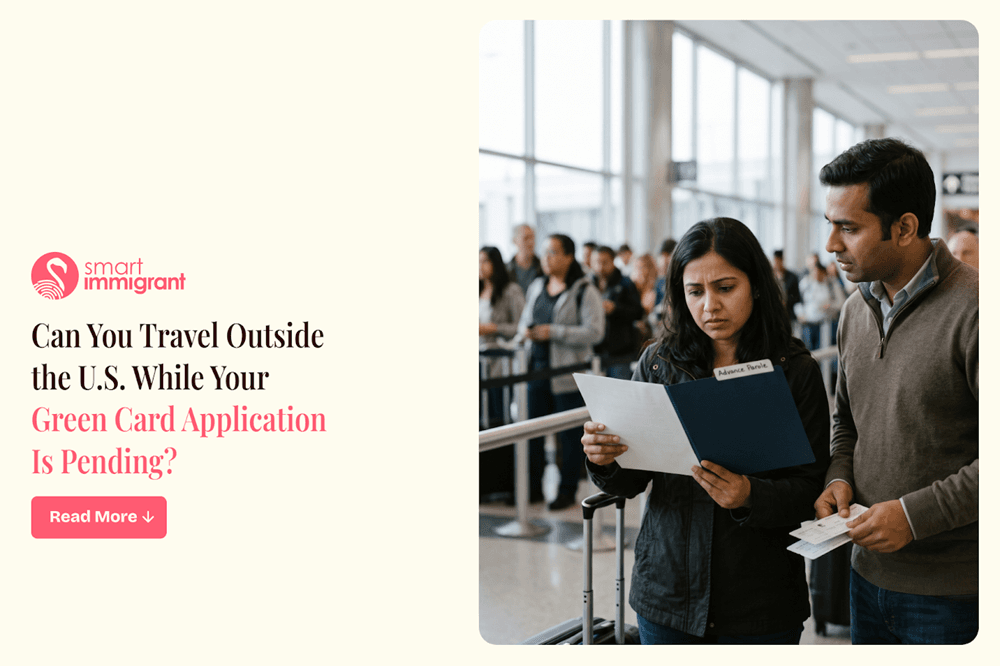
Can You Travel Outside the U.S. While Your Green Card Application Is Pending?
Traveling while your green card application is pending can carry significant risks, especially if you rely on advance parole or have a history of unlawful presence in the United States. Recent immigration developments may affect how international travel impacts your reentry eligibility, pending I-485 application, and future permanent residency.
Travel while green card pending used to be a dull question with a dull answer. You filed Form I-131, waited for the advance parole document, flew home for a wedding, came back. In August 2026 the Board of Immigration Appeals pulled a load-bearing wall out of that answer, and most pages you'll find on this subject still haven't caught up.
So before you book anything, read the next section.
The August 2026 Decision that Rewrote the Rules
On 13 August 2026, the BIA decided Matter of Delcarmen-Lara and overruled Matter of Arrabally and Yerrabelly, which had stood since 2012.
Under Arrabally, leaving the country on advance parole wasn't treated as a "departure" for the unlawful presence bars. That was the whole reason advance parole felt safe for anyone carrying an old overstay. You could travel and come home without tripping the three or ten year bar at INA 212(a)(9)(B)(i).
That protection is gone. A trip on advance parole now counts as a departure. If you've accrued more than 180 days of unlawful presence at any point in your history, leaving can make you inadmissible when you try to come back.
The Board applied its ruling prospectively, so trips taken before 13 August 2026 aren't affected. Anything after that date falls under the new rule.
Three groups are getting caught:
- DACA recipients who turned 18 before receiving DACA, or who had a gap in coverage
- TPS holders with unlawful presence predating their TPS grant
- Adjustment applicants carrying an old overstay somewhere in their history
That third group surprises people, because nothing about their US permanent residency case looks risky from the outside. You can be a decade into a stable career with a pending I-485 and a good employer, and still be carrying 200 days of unlawful presence from a student visa that lapsed in 2014. The bar doesn't expire quietly in the background. It sits there waiting for a departure, and now it has one.
Can I Travel while I-485 is Pending?
Yes, with the right document. Whether you should is now a separate question from whether you can.
Leaving the United States with a pending adjustment application and no valid travel document is generally treated as abandoning that application. USCIS can close your case while you're sitting in another country with no way to influence it. A narrow exception covers certain work visa holders, and it's further down this page.
For everyone else, the answer to "do I need advance parole" is a straight yes. People ask can I travel while I-485 is pending as though it's one question, and it's really two: is the trip permitted, and is it wise given what's sitting in your history.
How Long does Advance Parole Really take Now?
This is where the practical answer falls apart.
As of November 2026, USCIS completed 80% of Form I-131 advance parole cases within 26.5 months. Not weeks. More than two years.
Green card processing time has stretched across almost every form, but the travel document has quietly become the worst of them. Older guides telling you to file alongside your I-485 and expect the card within a few months are describing a system that no longer exists. If you're planning around a United States green card and assuming you keep the freedom to fly home each year, that assumption needs checking against the current green card processing time for the I-131 specifically. A United States green card application doesn't freeze your life, but the travel document attached to it moves slower than almost anything else USCIS touches.
What to do with that:
- Stop asking do I need advance parole and just file the I-131 with your I-485. Every time, even with no travel planned
- Don't book anything non-refundable until the document is physically in your hand
- For a genuine emergency, you'll need an expedite request or an in-person appointment at a USCIS field office, with documentation like a death certificate or hospital records
Can H-1B or L-1 Visa Holders Travel while their Green Card Application is Pending?
Yes, and this exception is worth knowing cold. Under 8 CFR 245.2(a)(4)(ii)(C), leaving without advance parole doesn't abandon your I-485 if you:
- Hold lawful H-1 or L-1 status and remain eligible for it
- Are returning to resume work for the same employer
- Have a valid H or L visa, where one is required
H-4 and L-2 dependents can generally travel on the same basis, as long as the principal keeps their status and the dependent holds a valid visa.
Plenty of people on H-1B file for advance parole, wait two years, and never use it, because travelling on the H-1B is cleaner anyway. Re-entering on advance parole means you're paroled in rather than admitted, which carries knock-on effects for your status that an H-1B entry simply doesn't create.
Your situation | Can you leave? | What you travel on |
H-1B or L-1 with valid visa, same employer | Yes | Your H or L visa |
H-4 or L-2, principal in status | Yes | Your dependent visa |
Pending I-485, no qualifying work visa | Only with approved advance parole | Advance parole document |
Any of the above, 180+ days past unlawful presence | Legally possible, seriously risky | Speak to an attorney first |
No advance parole, no qualifying visa | No | Leaving abandons your case |
What Happens if I Leave without Advance Parole?
Your adjustment application gets treated as abandoned. You're outside the country, the case is closed, and returning means starting something different from scratch.
The work visa exception above is the only reliable way around this, and it's narrow. Anyone moving from an F1 student visa to green card status through adjustment doesn't have it. If you're researching how to get green card in USA from a student status, build your travel plans around the advance parole timeline rather than assuming a flexibility that isn't there. The same applies to anyone pursuing US permanent residency through adjustment without an H or L underneath them. The F1 student visa to green card path runs almost entirely through adjustment, which is exactly why travel planning matters more on that route than on an employer-sponsored one.
Can I reenter the US if my Advance Parole expires while I'm abroad?
No. Whether you can reenter the US on an expired document is one of the most common questions we get, and the answer doesn't bend. You've got to be back before the expiration date printed on it.
An advance parole document that lapses while you're overseas can't be renewed from outside the country, and you can't file the replacement from abroad either. At that point, asking can I reenter the US gets you an answer you won't like. If yours is anywhere near expiry, file the renewal before you leave rather than after.
Will travel affect my green card application in other ways?
People usually ask will travel affect green card processing in terms of speed. It generally won't. The risks sit elsewhere, and here are the ones people don't see coming.
Your biometrics appointment. USCIS schedules these with limited notice. Miss one while abroad and your case can be flagged, though a reschedule request usually recovers it.
The officer at the port of entry decides. An approved advance parole document buys you permission to request entry. The officer still makes the call, and someone with a criminal record or a prior removal order can be refused right there.
A denial landing while you're away. If USCIS denies the I-485 while you're outside the country, you may have no status to return to at all.
J-1 holders. If the two-year home residency requirement applies to you, travel carries complications that don't affect anyone else.
What it costs in 2026
- Form I-131 with a pending I-485: $630 on paper, $580 online
- $0 if your I-485 was filed with a fee between 30 July 2007 and 1 April 2024 and remains pending
- A separate Immigration Parole Fee of $1,050 arrived with Pub. L. 119-21 in July 2025. Adjustment applicants returning from temporary travel are exempt, but you've got to prove the exemption. Carry your I-485 receipt notice and your advance parole document
So should you travel?
Travel while green card pending comes down to two separate checks. First, do you hold a document that lets you back in. Second, does anything in your past make that return risky.
On H-1B or L-1 with a valid visa and a clean status history, travel stays routine. It always has been.
Relying on advance parole with no unlawful presence behind you, the mechanics still work. You're just planning around a document that might not arrive this year or next.
And if there's any gap in your status history, going right back to your first entry, have someone look at it before you book. Anyone working out how to get green card in USA through adjustment should be auditing that history now rather than at the airport. The three and ten year bars don't care that the overstay happened a decade ago. Since August, a trip that used to be safe is what sets them off.
FAQ
Can I travel outside the U.S. while my I-485 green card application is pending?
Yes, if you hold approved advance parole or qualify for the H-1/L-1 exception. Leaving without either is generally treated as abandoning your application.
Do I need Advance Parole to travel internationally while waiting for my green card?
Yes, unless you're in valid H-1 or L-1 status, returning to the same employer, with a valid visa. H-4 and L-2 dependents qualify on similar terms.
What happens if I leave the U.S. without Advance Parole while my I-485 is pending?
USCIS generally treats the application as abandoned. You'd be outside the country with a closed case and would need to pursue a different route to return.
Can H-1B or L-1 visa holders travel abroad while their green card application is pending?
Yes. 8 CFR 245.2(a)(4)(ii)(C) protects them, provided they stay in status, return to the same employer, and hold a valid visa where one is required.
How long does it take to get an Advance Parole travel document after filing Form I-485?
As of November 2026, USCIS completed 80% of these within 26.5 months. File the I-131 with your I-485 and treat the document as unavailable until it arrives.
Can I reenter the U.S. if my Advance Parole expires while I am abroad?
No. You must return before the printed expiration date, and the document can't be renewed from outside the country.
Will traveling outside the U.S. affect my pending green card application or biometrics appointment?
It can. Missed biometrics appointments get flagged, though they're usually recoverable. The bigger risks are a denial issued while you're away and the admissibility decision at the port of entry.
Can USCIS deny my green card application if I travel internationally before it is approved?
Travel alone isn't a ground for denial, but leaving without a valid document can end the case through abandonment. Since August 2026, travel on advance parole can also trigger the unlawful presence bars for anyone with more than 180 days of past unlawful presence.