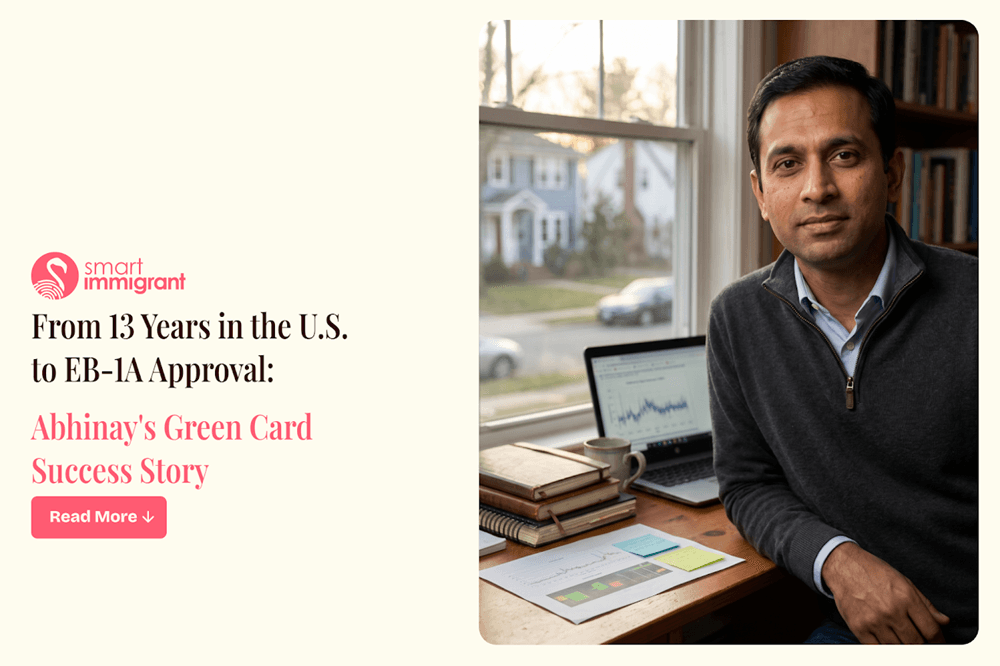
From 13 Years in the U.S. to EB-1A Approval: Abhinay’s Green Card Success Story
This case study outlines how Abhinay, a Finance Business Analyst specializing in AI in accounting, secured EB-1A approval after more than 13 years in the United States. With his green card journey stalled in the EB-2 backlog, he began exploring EB-1A as an alternative path to permanent residency. Although he knew EB-1A could be an option, he was unsure how to turn his existing professional work into a strong case. A personalized strategy identified opportunities across seven criteria, including original contributions, scholarly articles, judging, media, and Final Merits. His existing achievements were developed and positioned to demonstrate their significance and recognition within his field. His EB-1A petition was ultimately approved without an RFE.
- NationalityIndian
- FieldFinance & Accounting
Case At a Glance
Applicant | Abhinay |
Specialization | Finance Business Analysis, AI & Accounting |
U.S. Experience | 13+ Years |
Previous Path | EB-2 |
Program | Smart Immigrant |
EB-1A Criteria Focused On | Original Contributions, Scholarly Articles, Judging, Media & Final Merits |
Outcome | EB-1A Approved Without RFE |
How Did Abhinay Build a Career at the Intersection of Finance and AI?
Abhinay spent more than 13 years building his professional career in the United States as a Finance Business Analyst specializing in AI in accounting.
His work brought together finance, accounting, business analysis, and emerging AI applications. Over time, this gave him experience working on practical problems at the intersection of financial processes and technology.
The work he was doing also created opportunities to develop knowledge beyond his immediate responsibilities. Problems encountered in finance and AI later became the foundation for thought-leadership topics and scholarly publications.
By this point, Abhinay had built a substantial professional record. He simply had not been looking at that record through the lens of an EB-1A petition.
What Made the EB-2 Backlog a Problem After 13 Years in the U.S.?
Abhinay had previously pursued the EB-2 pathway as part of his long-term immigration plans.
But after more than 13 years in the United States, the backlog continued to leave his path toward permanent residency uncertain.
He already knew about EB-1A and understood that it could potentially provide another route.
The issue was not discovering the existence of EB-1A.
It was figuring out whether his own career could support one.
That meant looking beyond the fact that he had spent years working in finance and AI and examining whether his professional contributions, recognition, and expertise could be developed into qualifying evidence.
Why Was Knowing About EB-1A Not Enough for Abhinay?
Abhinay understood that EB-1A was based on extraordinary ability, but he did not know how to translate his day-to-day professional accomplishments into that framework.
Which of his achievements mattered most?
Which criteria could they support?
And how could individual pieces of evidence demonstrate something more significant about his professional standing?
This was where his journey with Smart Immigrant began.
A personalized profile assessment mapped his existing achievements across seven EB-1A criteria and identified the strongest areas for development.
The objective was not to start over. It was to uncover the EB-1A potential already present in the career Abhinay had built.
What Could Abhinay’s Existing Career Count Toward?
The assessment identified several areas where Abhinay's existing experience could support the petition.
EB-1A Evidence Area | Abhinay’s Achievement | Evidence & Significance |
Original Contributions | Real-world impact of his finance and AI work | Client appreciation emails helped demonstrate the practical value and impact of his contributions. |
Scholarly Articles | 10+ published papers | Problems he had solved in finance and AI became the foundation for relevant thought-leadership topics and publications. |
Judging | Professional evaluation experience | Relevant judging opportunities helped demonstrate expertise and recognition beyond his day-to-day role. |
Media | 7 major media outlets | A podcast appearance expanded his visibility and was followed by organic coverage in seven major media outlets. |
Final Merits | Broader professional recognition | His podcast, book, professional recognition, and other achievements were brought together to demonstrate the broader significance of his career. |
The value of the assessment was in connecting these accomplishments to a larger professional story rather than treating them as unrelated achievements.
How Did Abhinay Find EB-1A Evidence in the Work He Was Already Doing?
Once the strongest areas were identified, the focus shifted to developing evidence around them.
Turning Client Recognition Into Original Contribution Evidence
Abhinay already had client appreciation emails reflecting the value of his work.
These provided firsthand evidence of the practical impact of his contributions and helped establish how his work was being received outside his own description of it.
Turning Professional Problems Into Scholarly Work
His experience solving problems across finance and AI provided the foundation for new thought-leadership topics.
This work eventually resulted in 10+ published papers, adding a scholarly dimension to his existing professional expertise.
Expanding Recognition Through Judging
Relevant judging opportunities gave Abhinay a way to demonstrate that his expertise extended beyond his own professional responsibilities.
These activities provided evidence that his knowledge could also be relied upon when evaluating the work of others.
Building Visibility Through Media
Abhinay's podcast appearance created an opportunity to discuss his expertise publicly.
That exposure was followed by organic coverage in seven major media outlets, adding external recognition to his professional profile.
Bringing the Broader Record Into Final Merits
His podcast, book, professional recognition, and other achievements were considered alongside the evidence developed for individual criteria.
The purpose was to demonstrate the broader significance of his career rather than relying on one achievement to define the case.
The Challenges Along the Way
Abhinay's case involved several practical challenges:
- Determining which parts of a long professional career had the strongest relevance to EB-1A
- Demonstrating the significance of work performed in a professional setting
- Converting practical finance and AI experience into scholarly contributions
- Identifying judging opportunities relevant to his expertise
- Building recognition beyond his immediate professional environment
- Providing evidence that demonstrated impact rather than simply listing accomplishments
- Bringing different forms of evidence together for the Final Merits Determination
The process required Abhinay to look at familiar aspects of his career from a different perspective and understand what each could demonstrate.
The Outcome: Turning Strategy Into Success
Abhinay's EB-1A petition was approved without an RFE.
After more than 13 years in the United States, the approval gave him another path toward permanent residency beyond the EB-2 backlog.
For Abhinay, the significance was not simply that another immigration option had worked.
He had started with a career he already knew well but did not know how to translate into an EB-1A case. The process helped turn that existing professional record into a structured petition.
His approval demonstrated the value of identifying, developing, and presenting the evidence already embedded within a professional career.
What Does Abhinay’s Story Show About Finding EB-1A Potential?
You May Not Need to Start From Scratch
Years of professional experience can contain evidence that was never originally created for immigration purposes.
Look at Your Work Beyond the Job Description
The value of professional work can extend beyond assigned responsibilities. Impact, recognition, and outcomes can reveal a broader story.
Your Existing Expertise Can Create New Evidence
The problems you solve in your field can sometimes become the starting point for publications, judging opportunities, or other forms of professional recognition.
Evidence Needs Context
A publication, client email, podcast, or recognition becomes more useful when its significance and connection to your professional standing are clearly established.
The Bigger Picture Matters
Individual achievements may support individual criteria, but the overall case needs to communicate what those achievements collectively demonstrate about your professional career.
What If Your EB-1A Evidence Is Already in Your Career?
You may not need to build an entirely new professional profile.
The work you've already done, problems you've solved, recognition you've received, and expertise you've developed may contain more EB-1A potential than you realize.
The first step is knowing what to look for.
Book your free EB-1A profile review with Smart Immigrant and understand where your profile stands.
FAQs
Can a Finance Business Analyst qualify for EB-1A?
Professionals in finance, accounting, business analysis, AI, and related fields may pursue EB-1A when their achievements and supporting evidence meet the requirements of the category.
How many EB-1A criteria did Abhinay pursue?
Abhinay's profile was mapped across seven EB-1A criteria, with the strongest areas identified for evidence development.
How did Abhinay strengthen his scholarly profile?
Abhinay used problems and experiences from his work in finance and AI as the foundation for thought-leadership topics, resulting in 10+ published papers.
How did media recognition support Abhinay’s case?
A podcast appearance expanded his professional visibility and was followed by organic coverage in seven major media outlets, providing additional external recognition.
Can client appreciation emails support an EB-1A case?
Client feedback may serve as supporting evidence depending on its content, context, and connection to the applicable EB-1A requirements. In Abhinay's case, client appreciation emails helped demonstrate the practical impact of his professional work.
Was Abhinay’s EB-1A petition approved without an RFE?
Yes. Abhinay's EB-1A petition was approved without a Request for Evidence.