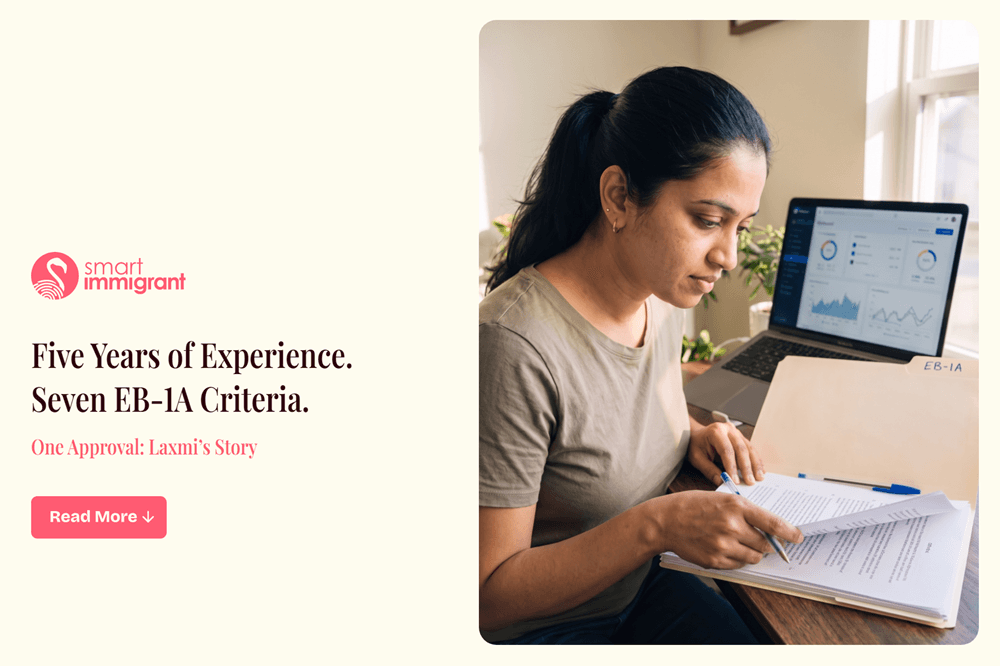
Five Years of Experience. Seven EB-1A Criteria. One Approval: Laxmi’s Story
This case study outlines how Laxmi, a data scientist with five years of professional experience, built an EB-1A profile after discovering the potential in her existing career. After holding a managerial role in data science in India and later completing her master’s degree in the U.S., she began exploring whether her achievements could support EB-1A. Her profile revealed potential across seven criteria, including scholarly articles, judging, critical role, original contributions, awards, membership, and media. With a customized strategy and continued effort, Laxmi developed evidence across these areas and strengthened the overall presentation of her profile. Her EB-1A petition was ultimately approved without a Request for Evidence.
- NationalityIndian
- FieldData Science
Case At a Glance
Profile | Details |
Applicant | Laxmi |
Experience | 5 years |
Previous Experience | Managerial role in Data Science in India |
U.S. Education | Master’s degree |
Program | Smart Green Card VIP |
EB-1A Criteria Targeted | Scholarly Articles, Judging, Critical Role, Original Contributions, Awards, Membership, Media |
Outcome | EB-1A Approved Without RFE |
How Did Laxmi Build Her Data Science Career So Quickly?
Laxmi had developed expertise in data science despite having only five years of professional experience. Before coming to the United States, she had already taken on a managerial position in the field in India, giving her an early foundation of professional responsibility.
She later pursued a master's degree in the United States and began working in the country after completing her studies. Her career was still relatively young, but the combination of her management experience, academic background, and professional accomplishments prompted her to consider whether she could pursue an extraordinary ability pathway.
That question led her to explore EB-1A more seriously.
What Made Laxmi Look at EB-1A So Early in Her Career?
Laxmi discovered that her professional profile might align with EB-1A requirements and submitted her details through the Smart Green Card VIP form.
The initial assessment found that she had a solid foundation to work with. Rather than waiting until she had accumulated many more years of experience, Laxmi decided to explore how her existing accomplishments could be developed into a structured EB-1A profile.
She joined the Smart Green Card VIP program and began working through a customized strategy designed around the evidence areas most relevant to her career.
What Was Already Hiding Inside Laxmi’s Profile?
The strategy identified seven EB-1A criteria for Laxmi to target: Scholarly Articles, Judging, Critical Role, Original Contributions, Awards, Membership, and Media.
Her profile already contained some of the building blocks. The process was about identifying those strengths, developing areas where more evidence was needed, and organizing everything around the requirements of an EB-1A petition.
EB-1A Criterion | Laxmi’s Evidence | What It Demonstrated |
Scholarly Articles | Existing papers and additional publications | Demonstrated her contribution to knowledge in data science |
Judging | Several judging activities in her field | Supported recognition of her expertise beyond her regular role |
Critical Role | Professional responsibilities and contributions | Supported the significance of her role in her work |
Original Contributions | Work that had been utilized by industry peers | Helped demonstrate the impact and value of her contributions |
Awards | Several professional awards | Added evidence of recognition for her achievements |
Membership | Professional memberships | Supported her professional standing |
Media | Multiple organic press coverages | Added external visibility and recognition of her achievements |
The significance of this stage was not simply identifying seven possible criteria. It gave Laxmi a clearer roadmap for understanding what evidence she needed, what she already had, and where she needed to develop her profile further.
How Did Laxmi Build the Evidence Behind Her Profile?
Turning Existing Work Into Original Contribution Evidence
One of the important discoveries came during a strategy session with Laxmi.
Her work had been utilized by industry peers in her field, creating an opportunity to develop evidence around the original contribution criterion. The focus then shifted to documenting that impact through strong Letters of Recommendation.
Laxmi was guided on how to approach potential recommenders and what elements the letters needed to address. She ultimately obtained multiple letters from individuals who had benefited from her work, providing supporting evidence for her original contributions.
Restarting a Publication Journey
Laxmi had already authored a few papers while studying at university, but she had not continued publishing after that.
Rather than treating those earlier papers as the end of her publication history, the strategy encouraged her to resume writing in her field. She worked on additional papers and gathered the relevant supporting evidence needed to strengthen the scholarly articles portion of her profile.
This allowed her academic work to become part of a broader professional narrative rather than remaining an isolated part of her university experience.
Expanding Recognition Through Judging and Awards
Judging was another area where Laxmi needed to build new opportunities.
She was assisted in identifying judging opportunities relevant to her field and gathering the supporting evidence required for the criterion. She subsequently participated in several judging activities.
The same approach was applied to awards. Potential opportunities in her field were identified and compiled for her to evaluate and pursue. Laxmi went on to secure several awards, adding another layer of professional recognition to her profile.
Taking Her Achievements Beyond Her Immediate Network
Laxmi had accumulated several milestones in her field, but those achievements also needed external visibility.
The Smart Green Card in-house press team developed a professional narrative around her accomplishments and pitched it to journalists at major media outlets. This resulted in multiple organic media coverages in major publications.
The media evidence added another dimension to her profile by demonstrating that her professional achievements had visibility beyond her immediate workplace.
The Challenges Along the Way
Laxmi's journey involved several areas that required continued effort:
- Building an EB-1A profile early in her career: With only five years of professional experience, she needed to make the significance of her achievements clear.
- Restarting scholarly publishing: She had authored papers during university but had not continued publishing afterward.
- Finding relevant judging opportunities: She needed to identify opportunities aligned with her data science expertise.
- Securing meaningful recommendation letters: Her original contribution evidence required people familiar with the impact of her work to provide supporting letters.
- Pursuing professional recognition: Awards and other recognition opportunities required active research and participation.
- Building external visibility: Her achievements needed to be presented through a professional narrative that could attract media interest.
- Keeping the evidence aligned: Each new achievement needed to support the broader EB-1A strategy rather than exist as a disconnected accomplishment.
The Outcome: Turning a Five-Year Career Into EB-1A Success
Laxmi ultimately secured EB-1A approval without a Request for Evidence.
Her journey demonstrates that the length of a career is only one part of the picture. Despite having five years of professional experience, she had already developed accomplishments that could be examined through multiple EB-1A criteria.
The process brought together her data science expertise, academic publications, professional contributions, judging activities, awards, and external recognition into a cohesive petition designed to address both the individual criteria and the final merits determination.
Reflecting on her experience, Laxmi shared:
“I wanted to express my gratitude to everyone on the Smart Green Card Team for supporting me every step of my EB1A path. Their role in my EB1A success is immense.”
She also highlighted the ongoing support available throughout the process:
“I truly value the incredible support offered by the Smart Green Card team. Whenever I gather evidence, I consult with them to ensure accuracy. They promptly provide the right guidance for the next steps. The team has consistently supported me throughout my EB1A journey and helped me overcome obstacles.”
What Does Laxmi’s Journey Show About Building an EB-1A Profile?
You Do Not Need Decades of Experience to Start the Conversation
Laxmi had five years of professional experience when she began exploring EB-1A. Her case shows why professionals should look at the substance of their achievements rather than relying only on the number of years they have worked.
Career length is one part of a profile. The nature, significance, and recognition of a professional's achievements matter too.
Your Earlier Achievements May Still Have Value
Laxmi had already written papers during university, but she had stopped publishing. Those earlier accomplishments became a starting point rather than something that had to be discarded.
Looking back at academic and professional work can sometimes reveal evidence that has been overlooked simply because it was not originally created with immigration in mind.
Building Evidence Requires Active Participation
An EB-1A strategy is not simply about identifying what someone already has.
Laxmi had to resume publishing, participate in judging, pursue awards, identify recommenders, and develop external visibility. Her dedication to carrying out those steps became an important part of building the overall profile.
What Could Your Career Reveal If You Look at It Differently?
Laxmi had around five years of experience in data science. What made the difference was not simply the length of her career, but understanding what her work could demonstrate.
Your résumé may tell you what you have done. The right strategy can help you understand what those achievements could mean for EB-1A.
FAQs
1. Can a data scientist with five years of experience qualify for EB-1A?
Professional experience alone does not determine EB-1A eligibility. A data scientist with five years of experience may have relevant achievements that can be evaluated against the EB-1A criteria.
2. Do I need to have published papers before starting an EB-1A case?
No. Scholarly articles are one potential EB-1A criterion. Existing publications may provide a starting point, while the overall profile needs to be evaluated across the applicable criteria.
3. Can work used by other professionals support an original contribution claim?
Potentially. Evidence showing that a professional's work has been utilized by others can be relevant when demonstrating the significance and impact of original contributions.
4. Can awards and judging activities strengthen a data science EB-1A profile?
Awards and judging are among the EB-1A criteria that may be relevant to a data science professional, depending on the nature and quality of the evidence.
5. Can media coverage be part of an EB-1A case?
Yes. Media coverage can potentially support an EB-1A profile when it provides relevant recognition of the applicant and their work, subject to the applicable requirements.