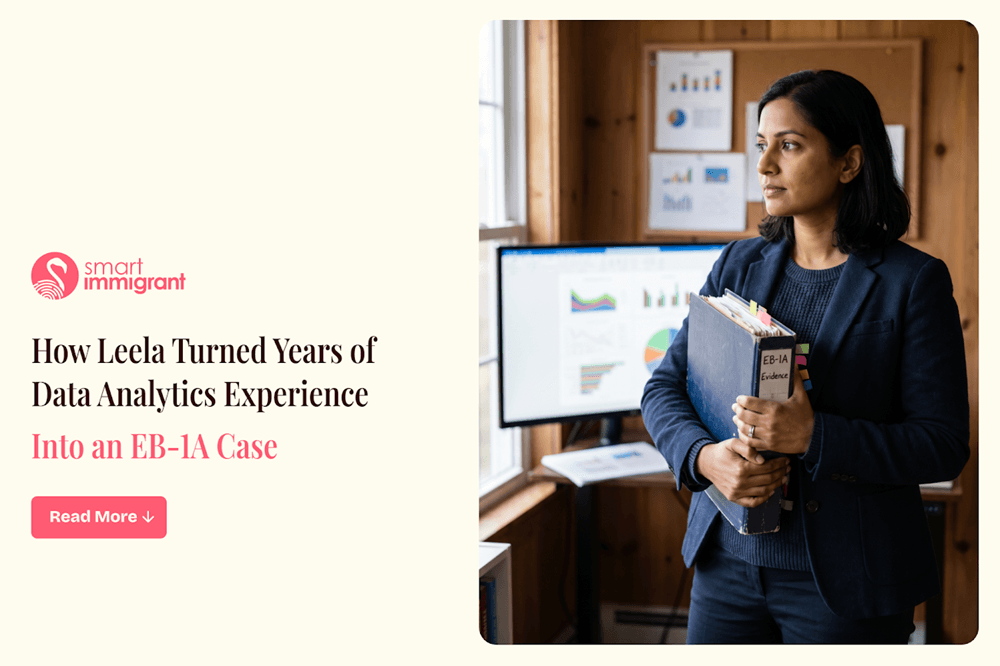
How Leela Turned Years of Data Analytics Experience Into an EB-1A Case
This case study outlines how Leela turned years of experience as a Senior Data Analyst in the health insurance sector into an EB-1A case. Facing long backlogs in traditional employment-based green card categories, she began exploring whether her professional achievements could support a different pathway. Her profile revealed potential across seven EB-1A criteria, including scholarly articles, judging, critical role, original contributions, awards, media, and membership. With a focused strategy, she developed and positioned evidence around her expertise, professional recognition, and contributions to the field. Her EB-1A petition was ultimately approved without a Request for Evidence.
- NationalityIndian
- IndustryHealth Insurance
Case At a Glance
Profile | Details |
Applicant | Leela |
Experience | Since 2006 |
Immigration Goal | U.S. Permanent Residency |
EB-1A Criteria Targeted | Scholarly Articles, Judging, Critical Role, Original Contributions, Awards, Media, Membership |
Outcome | EB-1A Approved Without RFE |
What Was Leela Building Through Years in Data Analytics?
Leela had been working as a Senior Data Analyst in the health insurance sector since 2006. Over the years, her career has given her substantial experience in a field where analytical expertise plays an important role in understanding data, supporting business decisions, and solving complex problems.
But like many experienced professionals, Leela had primarily viewed her career through the lens of her day-to-day work. Years of experience meant professional depth, but that did not automatically mean that her achievements were documented or presented in a way that demonstrated recognition beyond her regular role.
That distinction became important when she began exploring EB-1A.
Why Did the EB-2 and EB-3 Backlogs Change Leela’s Plans?
Leela’s goal was straightforward: she wanted a more secure long-term immigration future in the United States for herself and her family.
As an Indian professional, however, she was aware of the significant backlogs associated with traditional employment-based green card categories such as EB-2 and EB-3. She did not want to simply continue waiting without exploring whether her professional background could support another pathway.
Her search eventually led her to Smart Green Card through YouTube, where she came across Saiman’s explanation of EB-1A. For the first time, Leela began looking at her career not simply as years of employment, but as a collection of professional achievements that could potentially support an extraordinary ability petition.
That raised the more important question: Did her existing career actually have enough substance for EB-1A?
Leela Had the Experience. But Was It Enough for EB-1A?
Experience alone does not tell the full story of an EB-1A profile.
Leela had spent years developing expertise in data analytics, but she did not initially have a clear understanding of how her professional work could align with the different EB-1A criteria. She also had limited experience with activities such as scholarly publishing, judging, professional memberships, and media recognition.
The gap was therefore not simply a lack of achievements. It was the lack of a clear connection between her existing expertise and the types of evidence that could demonstrate recognition and influence in her field.
Once she joined the Smart Green Card VIP program, the focus shifted from asking whether Leela had “enough experience” to identifying where her professional expertise could credibly support an EB-1A case.
How Much EB-1A Potential Was Already in Leela’s Career?
The assessment identified potential across seven EB-1A criteria: Scholarly Articles, Judging, Critical Role, Original Contributions, Awards, Media, and Membership.
Rather than treating each criterion as an isolated requirement, the strategy was to build a broader picture of Leela as an experienced professional whose expertise extended beyond her regular job responsibilities.
The evidence areas included:
EB-1A Criterion | Leela’s Evidence | What It Demonstrated |
Scholarly Articles | Several papers in her field | Demonstrated her ability to contribute knowledge and expertise through published work |
Judging | Multiple judging opportunities | Demonstrated recognition of her expertise beyond her regular professional role |
Critical Role | Senior-level work in the health insurance sector | Supported the significance of her role within her professional environment |
Original Contributions | Professional contributions in data analytics | Helped demonstrate the value and impact of her work |
Awards | Professional recognition | Added evidence of recognition for her achievements |
Media | Organic coverage in major media publications | Provided external visibility and recognition of her professional expertise |
Membership | Three professional memberships | Supported professional standing through memberships requiring relevant qualifications |
The important shift was that Leela was no longer looking at her career as one long list of job responsibilities. Each professional achievement was being considered for what it could actually demonstrate about her expertise, recognition, and contribution to the field.
What Did It Take to Turn Leela’s Career Into an EB-1A Case?
Turning Data Analytics Expertise Into Scholarly Work
Scholarly publishing was an area where Leela had no significant prior experience. She had the professional knowledge, but translating that knowledge into meaningful research topics and publishable work required a different approach.
The process involved refining research ideas around her area of expertise, developing the papers, understanding publication requirements, and identifying appropriate journal opportunities. Over time, Leela authored several papers that added a new dimension to her professional profile.
This was not about treating publications as an isolated checkbox. The goal was to create scholarly work that was connected to the expertise she had already developed through years in data analytics.
Expanding Professional Recognition Through Judging
Judging was another area where Leela initially faced a practical challenge: she did not have an established history of judging professional or academic work.
The strategy therefore involved identifying relevant judging opportunities and developing approaches for securing those opportunities. Leela went on to participate in multiple judging activities, creating another form of external recognition for her expertise.
This helped demonstrate that her knowledge was not limited to the organization where she worked. Other professional settings were also relying on her experience and judgment.
Understanding the Right Kind of Membership
Professional memberships can look straightforward on paper, but not every membership carries the same evidentiary value.
Leela initially needed clarity around what types of memberships could actually support her EB-1A profile. The focus was therefore on identifying professional organizations whose membership requirements and standards were relevant to her accomplishments.
Through research and targeted opportunities, Leela secured three professional memberships that strengthened this part of her profile.
Building External Visibility Through Media
Media recognition became another avenue for demonstrating visibility outside Leela’s immediate workplace.
The focus was on developing a professional narrative around her expertise, publications, judging activities, and accomplishments. The press team supported outreach to journalists, while Leela’s existing professional work and achievements formed the substance of the stories.
This eventually resulted in several instances of organic media coverage in major publications, adding an external layer of recognition to her professional profile.
Bringing the Evidence Together
The final step was not simply collecting documents.
The different pieces needed to tell one coherent story: an experienced data analytics professional whose work, expertise, contributions, and recognition extended beyond her everyday job.
Each piece of evidence was organized around the criterion it supported, while the broader petition connected those individual achievements to the larger question of Leela’s standing in her field.
The Challenges Along the Way
Building an EB-1A profile from an established career does not mean every part of the process is straightforward. Leela encountered several challenges along the way:
- Starting scholarly publishing from scratch: She had professional expertise but no established history of publishing research.
- Finding suitable judging opportunities: Identifying opportunities relevant to her field required research and targeted outreach.
- Understanding membership requirements: Leela needed to distinguish between general professional memberships and memberships that could meaningfully support her profile.
- Creating external recognition: Media coverage required developing a compelling professional narrative and finding relevant publication opportunities.
- Connecting different achievements: Her publications, judging activities, memberships, professional contributions, and recognition needed to work together rather than appear as disconnected accomplishments.
- Maintaining consistency: Building multiple evidence categories required sustained effort and continued refinement throughout the process.
The Outcome: Turning Strategy Into Success
Leela’s EB-1A petition was ultimately approved without a Request for Evidence.
The approval represented more than the completion of an immigration process. It reflected a shift in how her years of professional experience had been understood and documented.
Her career in data analytics had always existed. What changed was the way her expertise, professional contributions, recognition, and external activities were brought together into a case that presented the full scope of her professional profile.
As Leela shared after the experience:
“The Smart Green Card Team has extensive expertise in EB1A subject matter. I followed their personalized strategies to gather evidence showcasing my expertise. Their approach worked for me, and I am thankful to them for it.” |
What Can Years of Experience Mean for EB-1A?
Experience Is Only the Starting Point
Years in a profession can provide depth, but EB-1A requires looking beyond the number of years someone has worked.
The more useful question is what that experience has enabled the professional to contribute, accomplish, and become recognized for.
Your Existing Career May Contain More Than You Realize
Leela did not begin with a profile built around publications, judging, media, or professional memberships. Many of those elements developed as she examined her existing expertise more closely.
That is an important distinction. Building an EB-1A profile is not necessarily about starting an entirely new career story. Sometimes it begins with understanding what is already there.
Evidence Works Better When It Tells One Story
Seven criteria do not automatically create a strong case.
The more important task is connecting the evidence so that it collectively explains the professional’s expertise, contributions, recognition, and standing in the field.
Leela’s journey shows how a long career can become more meaningful when its individual achievements are viewed as parts of a larger professional story.
What If Your Career Is Already Telling an EB-1A Story?
Years of experience can mean more than a job title on your resume.
Find out what your achievements could mean for your EB-1A profile.
Book your free consultation with our experts today to know your EB-1A future.
FAQs
1. Can a Senior Data Analyst qualify for EB-1A?
A Senior Data Analyst may qualify for EB-1A if their professional achievements and recognition meet the applicable requirements. Job title alone does not determine eligibility.
2. Do I need research papers for an EB-1A case?
Not necessarily. Scholarly articles are one potential EB-1A criterion among several. The relevant evidence depends on the individual’s professional profile.
3. Can professional experience from many years ago support EB-1A?
Yes, relevant professional experience and achievements can form part of an EB-1A profile. The key is demonstrating how that experience supports the applicable criteria and the overall case.
4. Can I pursue EB-1A without an employer sponsor?
EB-1A is a self-petition category, meaning qualifying individuals can petition for themselves rather than relying on an employer to sponsor the petition.
5. What should I do if I am unsure whether my profile qualifies for EB-1A?
Start by assessing your professional achievements against the EB-1A criteria rather than judging your profile only by your job title or years of experience. A detailed profile assessment can help identify potential evidence areas and gaps.