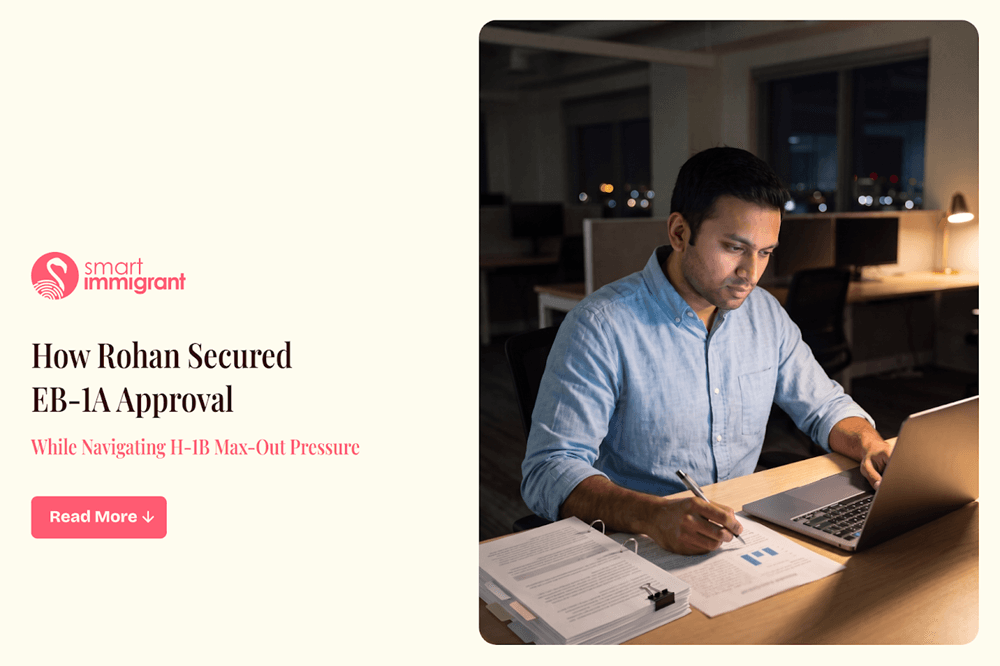
How Rohan Secured EB-1A Approval While Navigating H-1B Max-Out Pressure
This case study outlines how Rohan, a machine learning engineer specializing in recommendation systems, pursued EB-1A approval while approaching the six-year maximum of his H-1B status. When his employer paused the PERM process amid layoffs, he needed a way to address his immediate immigration concerns while continuing to build his EB-1A profile. With personalized guidance through Smart Immigrant VIP, Rohan developed evidence around his patent, research contributions, judging activities, publications, media recognition, and awards. He also pursued an EB-2 NIW petition, which was approved and helped him extend his H-1B status. His consistent effort ultimately led to EB-1A approval without an RFE.
- NationalityIndian
- FieldMachine Learning Engineering
Case At a Glance
Profile | Details |
Applicant | Rohan |
Immigration Challenge | Approaching the six-year H-1B maximum while his employer’s PERM process was paused |
EB-1A Strategy | Build evidence across eight targeted criteria and strengthen the final merits narrative |
Interim Immigration Pathway | EB-2 National Interest Waiver (NIW) |
Support Plan | Smart Immigrant VIP |
Key Evidence Highlights | Patent, research citations, judging activities, scholarly articles, five organic press pieces, awards, and conference participation |
Final Outcome | EB-1A petition approved without a Request for Evidence (RFE) |
What Made Rohan’s Machine Learning Experience Relevant to His EB-1A Journey?
Rohan specialized in recommendation systems, an area of machine learning that draws on technical expertise to help solve complex problems. His professional experience provided a foundation for building an EB-1A case, but identifying achievements was only one part of the process.
He needed to determine which aspects of his work could support the targeted EB-1A criteria and how to document their significance. His journey would require him to move beyond describing his technical responsibilities and toward demonstrating the contributions, recognition, and expertise reflected in his career.
Why Did Rohan Need an Immigration Strategy Beyond His Employer’s PERM Process?
Rohan initially relied on his employer to pursue an employment-based green card through the PERM process. However, his company paused that process twice because of recent layoffs, leaving him concerned as his H-1B status approached its six-year maximum.
While he was developing his EB-1A profile, the approaching deadline added urgency to his plans. He needed to consider his immediate immigration situation without abandoning the longer-term goal of building a strong EB-1A petition.
After reviewing his profile, the Smart Immigrant team recommended exploring an EB-2 National Interest Waiver (NIW). Rohan pursued that option alongside his ongoing EB-1A preparation. His EB-2 NIW petition was approved, helping him extend his H-1B status while he continued working toward EB-1A approval.
His experience illustrates how an immigration strategy may need to address both an immediate status concern and a longer-term green card objective. The right options depend on the individual’s circumstances and eligibility.
Could Eight EB-1A Criteria Help Rohan Present a Stronger Case?
Rohan’s personalized strategy targeted eight EB-1A criteria: Critical Role, Original Contribution, Judging, Scholarly Articles, Media, High Salary, Awards, and Memberships.
His existing patent and research citations offered starting points for documenting his contributions. Other areas required more deliberate effort, including securing judging opportunities and developing scholarly articles. Media coverage, awards, and conference participation added further dimensions to the way his expertise could be presented.
What Did Rohan’s Evidence Need to Demonstrate?
EB-1A Criterion | Applicant’s Evidence | What It Demonstrated |
Original Contribution | A patent from a previous employer and research papers cited by prominent researchers; a recommendation letter describing the impact of his work | Potential significance and influence of his technical contributions |
Judging | Participation in peer reviews, book reviews, and award judging | Engagement in evaluating the work of others in his field |
Scholarly Articles | Several co-authored papers developed around his expertise | Contributions to scholarly discussion in his area of specialization |
Media | Five organic press pieces in major publications | External recognition of his achievements and work |
Awards | Several awards secured in his field | Recognition through awards relevant to his professional area |
Critical Role | Identified as a target criterion in his personalized strategy; specific supporting evidence was not provided in the source material | The significance of a role must be established through case-specific evidence |
High Salary | Identified as a target criterion in his personalized strategy; specific salary figures and supporting documentation were not provided | Compensation evidence would need to support the applicable criterion |
Memberships | Identified as a target criterion in his personalized strategy; specific memberships were not provided | Membership evidence would need to establish that the relevant requirements were met |
Note: The table reflects the evidence described in the available case material. The detailed documentation for Critical Role, High Salary, and Memberships should be confirmed against Rohan’s case records before publication.
How Did Rohan Turn His Existing Achievements Into Stronger Evidence?
1. Original Contributions: Looking Beyond the Patent
During a strategy discussion, Rohan’s patent from a previous employer and citations to his research papers emerged as potential evidence of his contributions. The next step was to examine whether the patent represented a contribution of major significance within his field.
With guidance on evaluating that significance, Rohan obtained a recommendation letter from a relevant recommender at his former company. The letter described the impact of his work, helping connect his technical achievements to their wider relevance.
The key was not simply that a patent existed, but whether the supporting evidence could explain why the underlying work mattered.
2. Judging: Moving From Applications to Opportunities
Securing judging opportunities initially proved difficult, even after Rohan received a list of relevant openings. Rather than relying on general outreach, he worked on presenting his expertise more effectively and developing personalized pitches to editors.
This approach helped him secure opportunities to evaluate the work of others. His judging activities eventually included peer reviews, book reviews, and award judging.
For Rohan, progress in this area required persistence as well as a more focused outreach strategy.
3. Scholarly Articles: Building Confidence Through Collaboration
Rohan had not previously written scholarly papers and initially felt nervous about taking on the task. He needed direction on developing articles suitable for journals, along with greater confidence in his ability to contribute.
At his request, he was connected with other Smart Immigrant members working in his field. He used that community to collaborate and co-author several papers related to his expertise.
The experience helped him move from uncertainty about academic writing to actively contributing to scholarly work.
4. Media and Awards: Expanding Professional Recognition
Rohan’s strategy also included developing a narrative around his achievements and significant work. Smart Immigrant’s press team prepared that narrative and pitched it to journalists, while respecting their editorial independence.
The effort resulted in five organic press pieces in major publications. These features added an external perspective to the evidence being assembled for his case.
Rohan also received guidance on identifying awards in his field that he could apply for. That process resulted in several awards, adding another dimension to his professional recognition.
5. Final Merits: Connecting the Evidence to His Expertise
Meeting individual criteria was only part of Rohan’s preparation. The overall case also needed to communicate the significance of his achievements and the recognition he had earned.
Rohan was an active speaker and panel member at technology conferences. His team recommended incorporating this experience into the final merits presentation to help illustrate his visibility and engagement within the field.
The broader objective was to connect the different parts of his profile into a coherent account of his expertise and achievements, rather than treating each piece of evidence as an isolated accomplishment.
The Challenges Along the Way
Rohan’s journey involved more than collecting documents. He had to make progress across several evidence areas while managing uncertainty about his immigration timeline.
- H-1B time pressure: His six-year maximum was approaching while his employer’s PERM process remained paused.
- Uncertainty about the right path: He needed to address his immediate immigration concerns while continuing to develop his EB-1A petition.
- Limited judging opportunities: Finding relevant opportunities required persistence and more targeted outreach.
- Lack of scholarly writing experience: He initially doubted his ability to write papers and benefited from a more collaborative approach.
- Staying consistent: Rohan acknowledged that he procrastinated more during his self-paced plan and needed greater structure to keep his preparation moving.
These challenges called for both an evidence strategy and a process that could help him follow through on the work required.
How Did the VIP Program Help Rohan Stay on Track?
Rohan initially used Smart Immigrant’s self-paced course to learn about EB-1A and begin building his profile. However, he found it difficult to maintain consistent progress on his own and later upgraded to the VIP program for personalized guidance.
One feature that stood out to him was the project management system. Daily task notifications helped him stay aware of what needed to be completed and gave his evidence-building process more structure.
Reflecting on the difference, Rohan explained:
“While I was in the Self-Paced Plan (Ultimate Plan), I used to procrastinate a lot. But in the VIP program, their project management system is fantastic! I received constant notifications on my phone about my daily EB-1A tasks to complete. This kept me on track and provided the right direction to gather robust EB-1A evidence to showcase my expertise in the field.”
The structure mattered because Rohan was balancing several evidence-building activities alongside an approaching immigration deadline. The VIP program gave him a more guided way to keep making progress.
The Outcome: Turning Strategy Into Success
Rohan continued building his EB-1A profile while addressing the immediate concern surrounding his H-1B status. His EB-2 NIW petition was approved, helping him extend his H-1B status, and he continued working toward his primary objective.
With sustained effort and guidance throughout the process, Rohan secured EB-1A approval without receiving a Request for Evidence (RFE).
His experience brought together two important parts of his journey: developing a more comprehensive presentation of his professional achievements and maintaining momentum when the immigration timeline created additional pressure.
What Did Rohan Say About His Experience?
Rohan described the support he received throughout his journey in his own words:
“I can't thank the entire team at Smart Immigrant enough. They supported me throughout my EB1A journey until I achieved success. I sent them emails constantly, but they never got annoyed. Every question, no matter how simple, was answered with kindness and expertise. Trust me, follow the Smart Immigrant team’s guidance. They have a wealth of experience, and I've seen the positive results myself. The process can be overwhelming at times, but just have faith and trust in the process. When you finally get that visa approval, you'll thank them forever.”
— Rohan
What Can Other Machine Learning Engineers Learn From Rohan’s Journey?
Your Technical Work May Offer More Evidence Than You Realize
A patent, research citations, and contributions to a specialized field can provide useful starting points. The important next step is to assess the significance of those achievements and determine what documentation supports them.
You Can Build New Evidence Beyond Your Existing Experience
Rohan had limited scholarly writing experience and struggled to find judging opportunities at first. With a more focused approach and collaboration, he developed additional evidence instead of relying only on what he had already accomplished.
Immigration Timelines Require Careful Planning
Rohan’s approaching H-1B maximum made it important to evaluate his immediate options while continuing his EB-1A preparation. His EB-2 NIW approval helped address that concern in his particular circumstances, but immigration options and outcomes depend on individual eligibility and applicable rules.
Consistency Can Be as Important as Strategy
Knowing which evidence to develop is only one part of the process. Rohan’s experience with daily task notifications highlights how structure and accountability can help professionals make steady progress on a demanding application.
What Could Your Machine Learning Career Mean for Your EB-1A Potential?
You may already have years of specialized experience, research contributions, or work that has influenced your field. The question is how those achievements fit together, what evidence supports their significance, and what gaps may need attention.
Rohan’s journey shows the value of assessing a profile carefully, developing evidence strategically, and maintaining momentum when the process becomes overwhelming.
Your next step starts with understanding what your profile can demonstrate.
Book a free consultation with Smart Immigrant to discuss your achievements, explore your potential EB-1A pathway, and identify the evidence you may need to build a stronger case.
Frequently Asked Questions
1. Can a machine learning engineer qualify for an EB-1A visa?
Machine learning engineers may be eligible for EB-1A if they can demonstrate extraordinary ability through the applicable evidentiary requirements and satisfy the overall eligibility standard. Job title or technical expertise alone does not establish eligibility. The strength of the case depends on the individual’s achievements and supporting evidence.
2. What evidence can machine learning engineers use for an EB-1A petition?
Depending on their individual circumstances, relevant evidence may include significant technical contributions, patents, scholarly publications, citations, judging activities, awards, media coverage, and evidence of critical roles. Each item must be evaluated against the applicable EB-1A requirements; simply having an achievement does not automatically satisfy a criterion.
3. Can an EB-2 NIW petition help someone approaching the H-1B six-year maximum?
In certain circumstances, an approved EB-2 NIW petition and the related immigration process may be relevant to options for extending H-1B status. However, an NIW approval does not automatically guarantee an H-1B extension. Eligibility depends on the applicable rules and the person’s specific immigration history and circumstances.
4. Is it possible to build an EB-1A profile while working full-time?
It may be possible, but the process requires planning, documentation, and consistent effort. Professionals often need to balance their regular responsibilities with activities such as preparing publications, securing judging opportunities, documenting contributions, and gathering supporting letters. A structured plan can help organize this work.
5. Does EB-1A approval without an RFE guarantee the same result for other applicants?
No. Rohan’s approval without an RFE is the outcome of his individual case, not a guarantee for others. Each petition is assessed on its own evidence and merits, and USCIS may request additional evidence or deny a petition if the applicable requirements are not met.