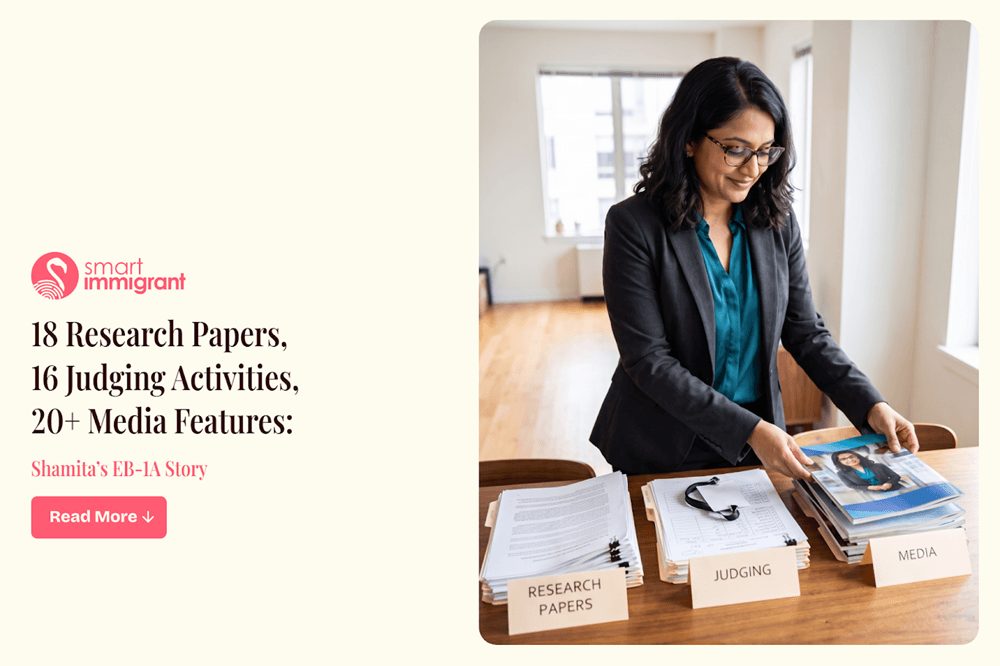
18 Research Papers, 16 Judging Activities, 20+ Media Features: Shamita’s EB-1A Story
This case study outlines how Shamita, a systems engineer specializing in Salesforce and digital transformation, developed her professional achievements into a stronger EB-1A petition. Although she had meaningful industry experience and some publications, she was unsure how to demonstrate her extraordinary ability. Over approximately six months, she expanded her scholarly portfolio to 18 co-authored research papers, participated in 16 judging activities, secured more than 20 media publications, and documented original contributions across three companies. With a more structured evidence strategy and guidance throughout the process, Shamita secured EB-1A approval without a Request for Evidence (RFE).
- NationalityIndian
- IndustryHospitality Technology
Case At a Glance
Profile | Details |
Applicant | Shamita |
Area of Expertise | Digital Transformation and Salesforce |
Immigration Goal | Obtain a U.S. green card through EB-1A |
Program | Smart Immigrant VIP |
Profile-Building Period | Approximately six months |
Key Evidence Highlights | 18 co-authored research papers, 16 judging activities, 20+ media publications, and original contributions across three companies |
Final Outcome | EB-1A approval without an RFE |
How Did Shamita’s Work in Digital Transformation Shape Her Professional Story?
Shamita worked as a systems engineer in digital transformation at a prominent hospitality technology company. Using Salesforce, she designed and implemented CRM tools that supported the customer-service capabilities her company was known for.
Despite her professional experience, she was concerned about her long-term future in the United States without a green card. She decided to pursue EB-1A but was uncertain about how her work and accomplishments could be presented against the requirements.
Her challenge was to move beyond describing her job responsibilities and identify evidence that demonstrated the significance of her achievements. That meant building on her existing experience while developing additional forms of professional recognition and documentation.
What Did Shamita’s Profile Need to Demonstrate?
Before joining Smart Immigrant, Shamita had professional accomplishments and some publications, but she needed greater clarity on how to build a case around them. Her strategy targeted seven EB-1A criteria: Membership, Critical Role, Original Contribution, Judging, Scholarly Articles, High Salary, and Media.
The focus was on identifying her existing strengths, developing additional evidence, and presenting her achievements in a way that addressed the applicable requirements.
EB-1A Criterion | Applicant’s Evidence | What It Demonstrated |
Scholarly Articles | 18 co-authored research papers developed through collaboration | A broader record of scholarly authorship in her field |
Judging | Participation in 16 judging activities, building on a couple of earlier peer reviews | Experience evaluating the work of others in her field |
Media | More than 20 media publications featuring her work in digital transformation | Visibility and recognition of her work across multiple industries |
Original Contribution | Contributions across three companies, supported by recommendation letters | The potential significance and impact of her professional work |
Membership | Membership opportunities were explored as part of her strategy; specific memberships were not provided | Evidence would need to establish that the relevant membership requirements were satisfied |
Critical Role | Identified as a target criterion; specific supporting evidence was not provided | Evidence would need to establish the significance of her role within an organization |
High Salary | Identified as a target criterion; salary figures and supporting documentation were not provided | Evidence would need to demonstrate that the applicable high-salary requirements were met |
The available case material does not confirm the specific evidence submitted for Membership, Critical Role, or High Salary. These details should be verified against Shamita’s case records before publication.
How Did Shamita Strengthen Her Evidence Beyond Her Existing Experience?
Turning Existing Publications Into a Broader Research Portfolio
Shamita had authored some publications before beginning her EB-1A journey, but they did not fully address the requirements she needed to meet.
Through collaboration with other members of the Smart Immigrant community, she went on to co-author 18 research papers. This expanded her scholarly portfolio and gave her additional work to document as part of her petition.
The progress required her to go beyond her initial experience and actively participate in collaborative research.
Building a Stronger Judging Record
Initially, Shamita had only a couple of peer reviews to draw on. She needed to identify further opportunities to demonstrate her experience evaluating the work of others.
With guidance on finding relevant opportunities, she participated in 16 judging activities. This helped broaden her record of judging beyond the limited experience she had before joining the program.
Expanding Media Recognition Across Industries
Shamita’s work in digital transformation became the subject of more than 20 media publications, covering industries such as pharmaceuticals, maritime shipping, and food and beverages.
The Smart Immigrant press team helped develop stories around her work and pitch them to media outlets. Journalists conducted written interviews with Shamita, allowing her to discuss her professional contributions with a broader audience.
According to the original case account, media interest continued organically even after active pitching stopped and after her EB-1A approval. This extended interest reflected the visibility her work had gained beyond her immediate professional environment.
Documenting Original Contributions Across Three Companies
Shamita had made original contributions during her work with three companies. These achievements formed the basis for recommendation letters intended to explain the nature and significance of her contributions.
The emphasis was on documenting what she had accomplished and obtaining support from people familiar with her work. This helped connect her professional experience to evidence of the impact of her contributions.
Exploring Membership and Award Opportunities
Her broader strategy also included exploring relevant memberships and awards. Guidance helped her identify opportunities and present her professional experience for consideration.
The available source material does not identify the specific awards or memberships Shamita secured. Those details should be confirmed before making more specific claims about their role in her approved petition.
How Did the Different Pieces of Evidence Support Her Overall Case?
Developing evidence across individual criteria was only part of Shamita’s preparation. Her petition also needed to present a coherent account of her expertise, achievements, and recognition.
The overall strategy focused on connecting her professional accomplishments with the evidence supporting them, rather than treating every paper, judging activity, or media feature as an isolated achievement. Her contributions across multiple companies, expanded research portfolio, judging experience, and media visibility formed different parts of that narrative.
The final merits determination is an overall assessment of the evidence and whether the applicant meets the applicable EB-1A standard. It is not simply a count of how many criteria or achievements an applicant can list.
The Challenges Along the Way
Shamita’s journey required consistent effort across several areas:
- Uncertainty about eligibility: She initially lacked clarity about how her professional experience could support an EB-1A petition.
- Limited scholarly publishing experience: Her existing publications needed to be supplemented with additional scholarly work.
- A small initial judging portfolio: She had only a couple of peer reviews before pursuing further judging opportunities.
- Building broader recognition: She worked to increase the visibility of her contributions through media coverage.
- Demonstrating the impact of her work: Her contributions across three companies needed to be documented and supported with relevant evidence.
- Organizing multiple evidence categories: Her profile required a structured approach to developing and presenting evidence across seven targeted criteria.
Over approximately six months, Shamita continued developing her profile and working toward a more comprehensive presentation of her professional achievements.
The Outcome: Turning Strategy Into Success
Shamita’s journey began with uncertainty about how her professional achievements could translate into a strong EB-1A petition. She expanded her scholarly work, participated in 16 judging activities, gained more than 20 media publications, and developed supporting evidence around her original contributions.
With guidance from Smart Immigrant and support from partner attorneys, Shamita secured EB-1A approval without receiving a Request for Evidence (RFE).
Her experience demonstrates the importance of identifying relevant achievements, documenting their significance, and presenting the evidence as part of a coherent case. Her professional experience provided the foundation; the work that followed helped her develop and organize the evidence needed for her petition.
What Changed When Shamita Had a Clearer Evidence Strategy?
Shamita’s experience was not simply about adding more achievements to her résumé. It involved understanding how her existing work could be documented, where her evidence needed strengthening, and how different accomplishments could support her overall case.
Her journey offers three important takeaways:
Your Professional Experience Can Be a Starting Point
Years of work in technology and digital transformation may provide valuable material for an EB-1A assessment. The next step is determining which achievements are relevant and what evidence can establish their significance.
Building Evidence Takes Consistent Effort
Shamita’s progress in scholarly authorship and judging required her to pursue new opportunities beyond her existing experience. A structured approach can help applicants identify gaps and work toward addressing them.
The Overall Case Matters More Than a List of Achievements
Research papers, judging activities, media coverage, and recommendation letters each serve different purposes. They need to be relevant, appropriately documented, and considered in the context of the full petition.
What Could Your Digital Transformation Experience Mean for Your EB-1A Potential?
You may have spent years developing enterprise systems, implementing Salesforce solutions, or leading digital transformation initiatives. But have you assessed which of your achievements could support an EB-1A petition—and what evidence you would need to demonstrate their significance?
Shamita’s journey shows the value of taking a closer look at your professional record and developing a strategy around your individual strengths and evidence gaps.
Your career has a story. Find out what your achievements could demonstrate.
Book a free consultation with Smart Immigrant to discuss your profile, explore your potential EB-1A pathway, and understand what evidence your case may need.
Frequently Asked Questions
1. Can a Salesforce professional qualify for EB-1A?
A Salesforce professional may qualify if they can demonstrate extraordinary ability through the applicable evidentiary requirements and satisfy the overall EB-1A standard. Experience with Salesforce or a senior job title alone does not establish eligibility. Each case depends on the applicant’s achievements and supporting evidence.
2. What evidence can support an EB-1A case in digital transformation?
Depending on the applicant’s background, evidence may include scholarly articles, judging activities, original contributions, media coverage, qualifying memberships, awards, and evidence of critical roles or high salary. Each item must be evaluated against the relevant requirements; possessing an achievement does not automatically satisfy a criterion.
3. Can research papers help a software or systems engineer qualify for EB-1A?
Scholarly articles may support the authorship criterion when they meet the applicable requirements. The number of papers alone does not establish extraordinary ability. Applicants should consider the nature of their publications and how the evidence contributes to the overall case.
4. Does media coverage guarantee EB-1A approval?
No. Media evidence must meet the applicable requirements and be evaluated in the context of the overall petition. The nature and relevance of the coverage matter, and having multiple publications does not guarantee eligibility or approval.
5. How long can it take to prepare an EB-1A petition?
Preparation time varies based on an applicant’s existing achievements, the evidence available, and the additional work needed to develop and document the case. Shamita’s preparation period with Smart Immigrant was approximately six months, but this should not be treated as a standard timeline or a guarantee for other applicants.