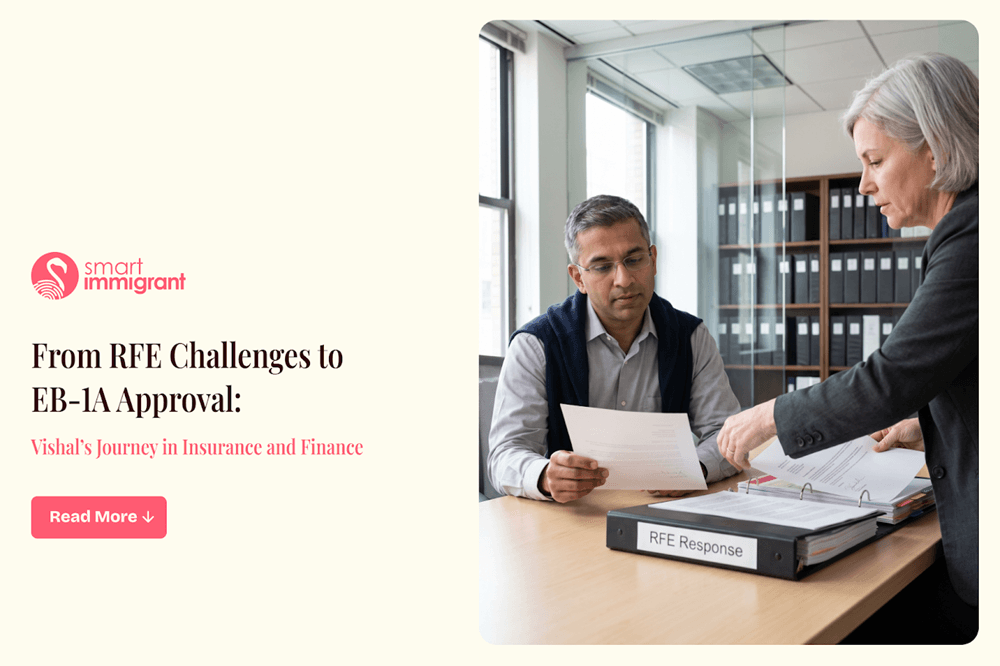
From RFE Challenges to EB-1A Approval: Vishal’s Journey in Insurance and Finance
This case study outlines how Vishal, a managerial professional in insurance and finance, pursued EB-1A despite doubts about the connection between his Ph.D. in chemical engineering and his work with AI- and ML-based underwriting models. As he developed his petition, he faced challenges demonstrating the major significance of his contributions and responding to Requests for Evidence (RFEs). With guidance from Smart Green Card, Vishal strengthened how he presented his research, pursued judging opportunities, and gathered testimonial letters from individuals who had benefited from his technology. He worked with his attorneys to prepare his RFE response and ultimately secured EB-1A approval.
- NationalityIndian
- FieldInsurance and Finance
Case At a Glance
Profile | Details |
Applicant | Vishal |
Educational Background | Ph.D. in Chemical Engineering |
Immigration Goal | Secure a U.S. green card through EB-1A |
Key Challenges | Doubts about his cross-disciplinary background and demonstrating the major significance of his work |
Evidence Focus | Scholarly articles, judging activities, original contributions, and testimonial letters |
Additional Support | Weekly live Q&A sessions with Saiman |
Final Outcome | EB-1A petition approved after an RFE response |
How Did Vishal’s Career Bridge Chemical Engineering, AI, and Finance?
Vishal worked in a managerial role in the insurance sector, where he was responsible for validating and approving underwriting models that used artificial intelligence and machine learning techniques.
Despite his professional experience, he questioned whether his academic background in chemical engineering aligned with his work in insurance and finance. The apparent disconnect made him uncertain about whether EB-1A was a realistic path for him.
That uncertainty became one of the first obstacles he needed to overcome—not by changing his career story, but by understanding how to present his expertise and achievements within the context of his actual work.
What Helped Vishal Move Past His Initial EB-1A Doubts?
When Vishal joined the Smart Green Card program, he had questions about his eligibility and how to approach the petition. One of his main concerns was whether his Ph.D. in chemical engineering would work against him because his professional responsibilities were in another field.
The guidance he received helped him understand that his case needed to focus on demonstrating extraordinary ability through the applicable EB-1A requirements, rather than assuming his educational background alone determined his eligibility.
Vishal later reflected on the impact of that guidance:
“Sometimes misconceptions don’t allow us to move forward. I am grateful that I found the Smart Green Card Team; they unblocked my EB1A path earlier.”
The clarification gave him a more focused starting point: identify the strengths of his professional record, understand the evidence needed, and build a case around the work he had actually done.
How Did Vishal Approach the EB-1A Criteria?
Vishal joined Smart Green Card before the VIP plan was introduced. During his preparation, he received guidance on presenting his scholarly articles, pursuing judging opportunities, and demonstrating original contributions.
Unlike applicants who begin developing scholarly work from scratch, Vishal had already authored papers through his research and doctoral studies. The challenge was to present those papers effectively and connect them to the broader impact of his work.
His preparation therefore focused not simply on collecting evidence, but on explaining what it demonstrated and why it mattered to his field.
What Did His Evidence Need to Show?
EB-1A Criterion | Applicant’s Evidence | What It Needed to Demonstrate |
Scholarly Articles | Papers Vishal had authored before joining the program | The relevance of his scholarly work and its connection to his area of expertise |
Judging | Evidence gathered through judging opportunities | His participation in evaluating the work of others in his field |
Original Contribution | Research and technology that had been used by others, supported by testimonial letters | The significance and impact of his contributions beyond his own work |
The central challenge was making the significance of Vishal’s achievements clear through supporting evidence, particularly when USCIS questioned whether his original contributions had major significance.
Why Did Vishal’s Original Contributions Become a Key Challenge?
Vishal’s work had been used by others in his field, giving him a potential basis for demonstrating its broader impact. To document that connection, he submitted a recommendation letter from his Ph.D. advisor and obtained independent letters from individuals who had cited his work.
However, this evidence did not resolve the adjudicating officer’s concerns, and Vishal received a Request for Evidence (RFE).
The RFE highlighted an important distinction in his case: showing that research or technology exists—and that others have encountered or used it—is not necessarily the same as establishing that the contribution is of major significance to the field.
Vishal needed to respond to the specific concern raised by USCIS rather than simply submit more material of the same kind.
How Did Vishal Strengthen His RFE Response?
After reviewing the RFE and the evidence in Vishal’s case, the Smart Green Card team helped identify a more targeted approach to documenting the impact of his work.
Vishal reached out to people who had benefited from using his technology and secured two testimonial letters from them. These letters were intended to provide a more direct account of how his work had been used and why it mattered to those who relied on it.
This approach shifted the emphasis toward evidence from individuals who could speak to the practical impact of his contributions.
With guidance from Smart Green Card and assistance from his attorneys, Vishal prepared his RFE response and ultimately received EB-1A approval.
His experience demonstrates why an RFE response needs to address the officer’s specific concerns. The goal is not merely to add documents, but to identify what the existing record has failed to establish and provide relevant evidence to address that gap.
What Did Vishal Gain From Weekly Live Q&A Sessions With Saiman?
For Vishal, access to weekly live Q&A sessions was another important part of the program. These sessions allowed members to ask Saiman questions directly and clarify uncertainties about the EB-1A process.
One session helped Vishal better understand premium processing. He learned that premium processing expedites the adjudication process; it does not change the underlying evidentiary requirements or guarantee approval.
Following that clarification, Vishal upgraded his petition to premium processing and received a decision faster.
The experience reinforced the value of getting clear answers to procedural questions rather than making decisions based on misconceptions.
The Outcome: Turning Strategy Into Success
Vishal’s EB-1A journey involved uncertainty, an RFE, and the need to strengthen how he demonstrated the impact of his work. He continued working through those challenges, gathering additional testimonial evidence and preparing a response that addressed the concerns raised by USCIS.
With support from Smart Green Card and his attorneys, Vishal secured EB-1A approval after responding to the RFE.
Looking back, he highlighted the role of the strategy and evidence-gathering process:
“I appreciate Saiman and the team’s approach to navigating RFE. Added to that, the Smart Green Card Strategies assisted me in gathering compelling evidence for EB1A.”
— Vishal
His story is a reminder that an RFE is a request to address specific concerns in a petition. The response requires a careful assessment of what USCIS has questioned and evidence that directly addresses those issues. An RFE does not guarantee approval, but a well-targeted response can give an applicant the opportunity to address deficiencies in the record.
What Can Professionals in Insurance and Finance Learn From Vishal’s Journey?
Your Educational Background Does Not Tell Your Entire Professional Story
Vishal’s Ph.D. was in chemical engineering, while his work involved AI- and ML-based underwriting models in insurance. Rather than allowing the difference to define his prospects, he focused on understanding how his actual expertise and achievements could be documented.
Demonstrating Impact Requires More Than Describing Your Work
A professional contribution may be technically complex, but a petition also needs evidence of its significance. Vishal’s experience illustrates the value of seeking out people who can explain how they used his work and what impact it had.
An RFE Requires a Targeted Response
When USCIS raised concerns about the significance of his original contributions, Vishal’s next step was to address those concerns with more relevant testimonial evidence. Applicants should review the specific issues in an RFE with their qualified immigration counsel and develop a response that addresses the record carefully.
Clarifying Misconceptions Can Help You Make Better Decisions
Vishal’s questions about his academic background and premium processing influenced how he approached his case. Reliable guidance helped him understand the requirements and procedural options more clearly, allowing him to make more informed decisions.
Could Your Professional Achievements Support an EB-1A Case?
You may have advanced degrees, years of industry experience, research contributions, or technology that others use in their work. But how do you determine which achievements are relevant—and whether your evidence demonstrates their significance?
Vishal’s journey shows why a careful profile assessment and a clear evidence strategy matter, especially when your career spans different disciplines or your petition encounters an RFE.
Your career story may be more connected than you think. The key is knowing how to demonstrate it.
Book a free consultation with Smart Immigrant to discuss your professional achievements, understand your potential EB-1A pathway, and identify the evidence your case may need.
Frequently Asked Questions
1. Can someone with a Ph.D. in one field apply for EB-1A while working in another?
A Ph.D. in the same field as an applicant’s current job is not, by itself, a universal EB-1A requirement. Eligibility depends on demonstrating extraordinary ability in the relevant field through the applicable evidentiary requirements and satisfying the overall standard. Applicants should assess how their education, work, and achievements fit together in their individual cases.
2. What is an RFE in an EB-1A petition?
An RFE, or Request for Evidence, is a notice from USCIS requesting additional evidence or clarification before making a decision. Applicants should carefully review the specific issues raised and work with their immigration counsel to prepare a response that addresses those concerns.
3. How can applicants demonstrate that their original contributions are significant?
Depending on the case, relevant evidence may include documentation of how the work has been used, independent expert letters, evidence of practical impact, citations, or other materials that establish the contribution’s significance. The appropriate evidence depends on the nature of the contribution and the concerns that need to be addressed.
4. Does receiving an RFE mean an EB-1A petition will be denied?
No. An RFE means USCIS has identified issues for which it wants additional evidence or clarification. The final outcome depends on the petition as a whole, the response, and whether the applicable requirements are satisfied. Approval is not guaranteed.
5. Does premium processing improve the chances of EB-1A approval?
Premium processing expedites adjudication under the applicable USCIS rules; it does not lower the evidentiary standard or guarantee approval. Applicants should evaluate processing options based on their circumstances and current USCIS requirements.
Explore More Smart Green Card Success Stories
Vishal’s experience is one example of a professional navigating complex evidence requirements on the way to EB-1A approval. Explore our [success stories in our case studies] to learn how other professionals approached their own immigration journeys.